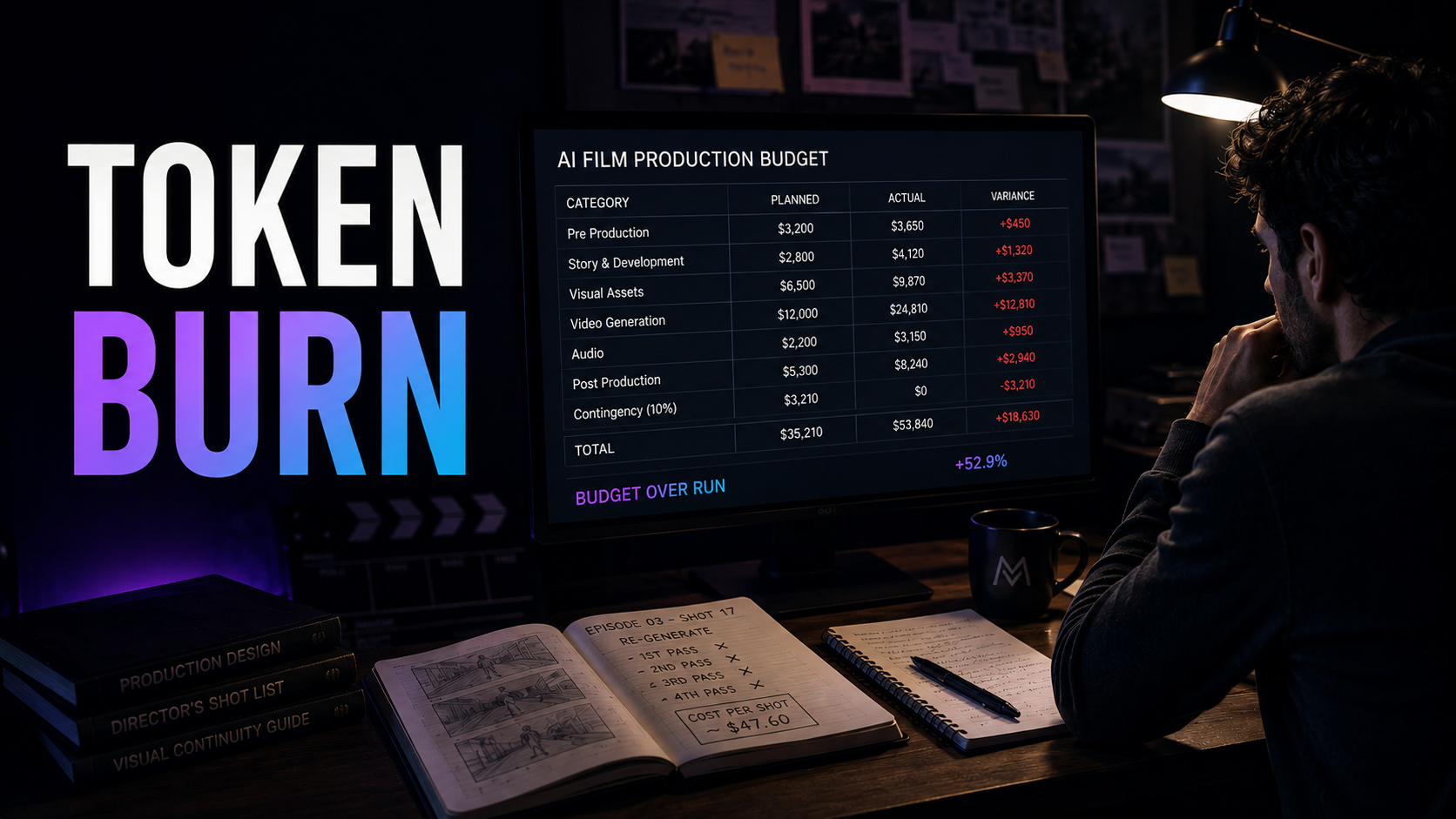
Nobody warns you about token burn when you start making AI films or microdramas. You set a budget, you pick your models, you start generating. And somewhere around shot 15 or 20, things start feeling more expensive than they should. You are regenerating shots you thought were done. You are fixing consistency problems that appeared out of nowhere. You are spending time and money on a problem you did not plan for. That problem has a name. It is called token burn, and it is the hidden production budget that determines whether your AI film or microdrama actually gets finished on time and on cost.
This Is Not Like Image Generation
If you have worked with AI image generation before, you probably have a sense of what things cost. You run a prompt, you get an output, you decide if it works. The cost is predictable because each transaction is relatively isolated. AI video production for films and microdramas is a completely different animal.
You are not running isolated transactions. You are running interconnected pipelines where every node affects every other node. Your character generation informs your scene generation. Your scene generation depends on your world building. Your world building needs to be consistent with your color language. And when something goes wrong in any one of those layers, the fix does not cost you one shot. It costs you a cascade of shots downstream.
That compounding is the thing that wrecks budgets. And if you are making microdramas specifically, where you might have 8 to 12 episodes and a lead character appearing in 30 shots per episode, a single anchor problem can cascade across hundreds of generation passes.
There Are Three Places Your Budget Actually Goes
Once you understand this, you can start managing it. The burn in any AI film or microdrama production falls into three buckets and most people only budget for one of them.
The first is planning burn. This is everything that happens before you generate a single video frame. Prompt engineering, character briefs, storyboards, world building documents, shot breakdowns. People treat this as free because they are using text models and the per-token cost looks negligible. But a 40-shot microdrama episode with multiple iteration rounds on character briefs and anchor documents adds up. More importantly, planning burn done poorly is what causes everything else to blow up later.
The second is generation burn. This is the obvious one and the only one most people budget for. Image generation passes, video generation passes, audio. The trap here is assuming you will get acceptable output on the first or second pass. Professional AI film production runs closer to three to five passes per hero shot to reach production quality. If your budget assumed one-to-one, you are already underwater.
The third is continuity burn, and this is the one that quietly destroys productions. Every time a character drifts between scenes, every time a background texture shifts between episodes, every time a lighting anchor breaks across a cut, you are not just fixing one shot. You are potentially rerunning an entire scene to restore coherence. In microdrama production where visual consistency across episodes is the actual product, continuity burn is where budgets go to die.
What a Real Continuity Cascade Looks Like
Let me make this concrete. You are producing a microdrama episode, 40 shots, one lead character. You generate through shot 22 and everything looks solid. Then in review you notice the character's face has drifted. Subtle but visible. You trace it back and the drift started at shot 15. Now shots 15 through 22 all carry the problem. Eight shots need audit. Some need partial regeneration. Some need full regeneration. Your 40-shot episode just became a 55-shot production budget-wise and you have not even finished the first pass yet.
That is not a production failure. That is what happens when you do not have an anchor system locking your character reference before generation starts. The cascade is predictable. It is also entirely preventable with the right architecture.
How MinionArts Vertex Is Built Around This Problem
This is exactly why Vertex was built as a node-based AI film production platform rather than a linear generation tool. In a linear workflow, you generate and hope consistency holds. In Vertex, your character references, world building documents, color definitions, and reference videos are anchor nodes with a formal lock state. A downstream shot node cannot execute against an unlocked anchor. The cascade cannot happen because the system does not allow it.
The storyboard drives the pipeline architecture. Before a single production shot generates, the storyboard has defined which anchors each shot depends on and in what order those anchors need to lock. The burn is concentrated upfront in anchor creation and validation, where fixing problems is cheap. Generation happens against locked context, where continuity burn is structurally prevented rather than caught in expensive review cycles.
For microdrama studios producing at series scale, this is not a nice-to-have workflow improvement. It is the difference between a production budget that holds and one that compounds into something unrecognizable by episode three.
Token burn is the cost nobody talks about when they pitch AI film production as cheap and fast. It is real, it compounds, and it is manageable. But only if you build your production system around it from the start.