The Graph Will Set You Free
In early 2025, a viral essay titled "The Graph Will Set You Free" circulated among creative technologists. The thesis: every major creative software will eventually become a node graph, because graph structures are the only interface paradigm that naturally represents the way complex creative production actually works — as a sequence of connected transformations, not as a single tool with a single output.
The evidence for this prediction has arrived fast. Adobe launched Project Graph. Figma acquired Weavy and integrated visual workflow logic into its canvas. FLORA built its entire AI platform around a node graph interface. Krea launched Nodes. Freepik launched Spaces. And MinionArts built Vertex — a node-based canvas specifically designed for AI video production.
The convergence is not coincidental. It reflects a genuine shift in how creative work is structured when AI models are involved.
What a Node Actually Is
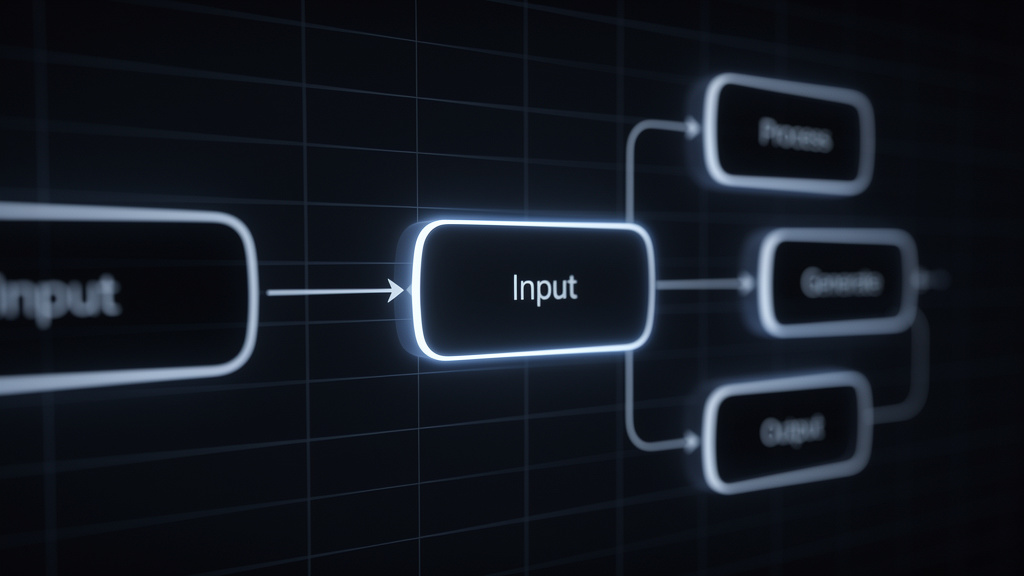
In the context of AI creative workflows, a node is a discrete step in a production process. It has inputs — data, files, or parameters coming in — and outputs — processed data or files going out. Connecting nodes together creates a pipeline where the output of one step automatically becomes the input of the next.
The simplest possible example: an image generation node takes a text prompt as input and produces an image as output. An animation node takes that image as input and produces a video clip as output. An audio node takes a script as input and produces a voiceover file as output. A merge node takes the video and audio files as inputs and produces a combined video as output.
Each of these steps is a node. The connections between them are edges. The complete connected sequence is the workflow.
Why This Matters More Than It Sounds
Before node-based workflows, AI-native creative production was a series of disconnected manual steps. You used one tool for image generation. You downloaded the output, opened a different tool for animation, uploaded the image, ran the animation, downloaded the clip, opened a third tool for voiceover, uploaded the script, generated the audio, downloaded it, and brought everything into a video editor to combine and export.
Every step required a manual handoff. Every handoff introduced error surface — wrong file format, incorrect naming, version mismatch, forgotten parameter settings. And every campaign required the entire sequence to be executed from scratch.
Node-based workflows eliminate the manual handoffs by making the connections explicit and automatic. Once the workflow is built, the pipeline runs from input to output without manual intervention at each step. The only human decisions are the creative ones: what prompt, which reference, which output format.
The Four Properties That Define a Good Node-Based Creative Workflow
1. Determinism
The same inputs, run through the same workflow, should produce comparable outputs every time. The workflow is a repeatable production template, not a one-time experiment.
2. Composability
Nodes should be interchangeable. If you want to swap Kling 2.1 for Veo 3 in your animation step, you should be able to replace that one node without rebuilding the entire workflow.
3. Parallelism
Where steps are independent of each other, the workflow should be able to run them simultaneously rather than sequentially. In a six-variation campaign, all six image generations can run in parallel rather than queuing.
4. Transparency
Every node in the workflow should show its current state — running, complete, failed — and every output should be inspectable before the next node runs. The workflow is not a black box.
How Different Tools Approach This
Adobe Project Graph is Adobe's entry into visual AI workflow tooling, positioned primarily for professional video and motion graphics workflows. It integrates with Adobe's existing model infrastructure. Still in early development as of April 2026.
FLORA is the most mature node-based AI canvas currently available, with 50+ models accessible through a polished graph interface. Image and design-focused. Netflix and Pentagram are production users. Not built around video ad production pipelines.
Krea Nodes is an image-generation-focused node interface from Krea, emphasizing style transfer and image processing chains. Sophisticated but narrow in scope.
MinionArts Vertex is the only node-based AI canvas built specifically for video production pipelines — connecting image generation, video animation, voiceover, audio merge, and format export in a sequence designed to produce complete campaign deliverables. The batch production architecture and multi-model support (Nano Banana, Kling, Veo 3, ElevenLabs) make it the most complete production-oriented implementation of the node paradigm currently available.
What This Means for Creative Teams in 2026
The adoption curve for node-based AI workflows in creative production is early but accelerating. Teams that invest in understanding this paradigm now — building workflow templates, training team members on the canvas interface, integrating it into client production processes — will have a structural advantage in 2026 and 2027 that latecomers will not easily replicate.
The learning curve is real. Node-based thinking requires a different mental model than point-and-click tool use. But the efficiency gains — measured in hours per campaign, cost per asset, and team capacity — compound quickly once the first three or four workflow templates are built.
The trajectory: In 2024, node-based AI workflows were a niche concept used by technical creative directors. In 2026, they are the emerging production paradigm being adopted by every major tool in the space. By 2028, they will likely be the default interface for professional AI creative production. The teams building fluency now are building a skill that will be foundational within 24 months.