Access to Models Is Not the Problem Anymore
In 2023, having access to Midjourney was an advantage. In 2024, having access to Kling or Veo was an edge. In 2026, every model is either free-tier accessible or cheap enough to expense without approval. The competitive advantage from model access is gone.
The teams winning now are not winning because they have better models. They are winning because they have better systems.
That is what Vertex is.
What Vertex Actually Is
MinionArts Vertex is an AI-powered content production platform built on a node-based workflow canvas. It is the infrastructure layer between your creative brief and your finished assets.
Think about how Figma changed design work. Before Figma, every designer had their own local file, their own Photoshop version, their own export process. After Figma, the canvas was shared, the workflow was visual, and collaboration was built into the structure rather than added on top.
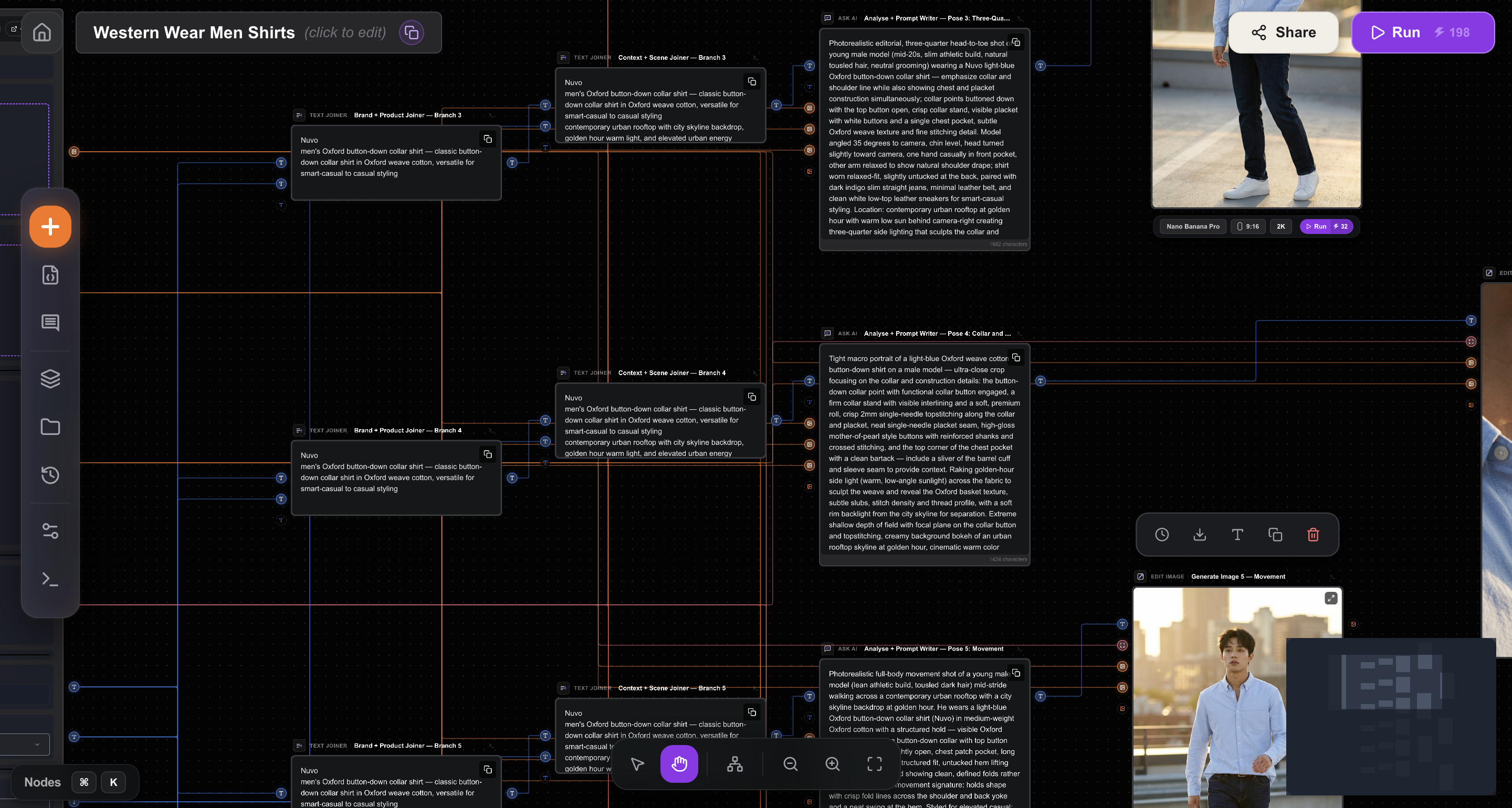
Vertex does the same thing for AI production. Instead of each team member using their own set of tools in their own order with their own settings, the production pipeline becomes a shared system. Nodes represent steps. Edges represent the flow of assets between steps. The workflow itself becomes the product.
How the Node System Works
Every production task in Vertex is a node. Nodes have inputs and outputs. You connect them with edges, directed flows that pass data from one node to the next.
A simple campaign workflow looks like this: a product image upload node connects to a Nano Banana generation node, which connects to a Kling animation node, which connects to an ElevenLabs voiceover node, which connects to an output export node. Draw the connections, configure the parameters on each node, and run the pipeline.
What Makes It Different From Using Tools Individually
Repeatability
When you produce manually, every campaign starts from scratch. In Vertex, you build the workflow once and save it as a template. Every subsequent run starts from that working template. The knowledge is stored in the system, not in a person.
Scale Without Headcount
A single workflow template with batch execution can process 50 product SKUs in the time it would take a person to manually produce one.
Multi-Model Orchestration
Vertex connects to Nano Banana, Kling, Veo 3, ElevenLabs, Seedance, and other models. You do not switch between platforms. You control everything inside one system.
Credit Efficiency
Vertex lets you define parameters, run controlled batches, and evaluate outputs systematically. Less waste, lower credit spend, faster iteration cycles.
The Distinction
Vertex is not the tool you use to make one video.
It is the system you build once so your team can produce 100 assets with the effort it used to take to produce 5.
Who Vertex Is Built For
Agencies
Your output capacity is constrained by headcount. Vertex removes that constraint.
D2C Brand Teams
You have product images. You have campaign briefs. Vertex turns your catalog into inputs and your briefs into repeatable workflows.
Solo Creative Directors
You have taste and strategy. Vertex becomes your execution engine.
Filmakers:
You can do your pre-visualizations, build micro-dramas and cinematic sequences.
The Platform Frame
We call Vertex an AI-powered content production platform because that is what it actually is.
A platform does not just execute tasks. It connects systems, standardizes workflows, and enables scale.
Vertex connects your AI models the way a production system should. Nano Banana, Kling, ElevenLabs are execution layers. Vertex is where everything comes together and runs as one system.