Scene transitions and pacing determine how a 90 second microdrama episode feels once its shots are cut together, and they are decided as deliberately as any camera choice. A perfectly generated set of shots can still fail an episode if the cuts between scenes are too slow, too abrupt, or evenly timed when the story needs acceleration. In 2026, editing pace is treated as its own craft discipline in microdrama production, not an afterthought handled automatically once generation is done.
Why pacing is different for a 90 second format
A feature film can let a scene breathe for its own sake. A 90 second microdrama episode cannot, because every second not actively building toward the episode's ending hook is a second where a viewer with a thumb on the screen can leave. This does not mean every cut has to be fast. It means every cut has to be earned, and pacing decisions should track against the episode's hook structure: scenes early in the episode can run slightly longer to establish stakes, while scenes approaching the ending cliffhanger should tighten, with shorter shots and quicker cuts building momentum into the final frame.
Pacing in this format is best understood as a curve rather than a fixed rhythm. An episode that cuts at the same tempo from first frame to last, regardless of what is happening in the story, feels monotonous even if each individual cut is technically well timed. The goal is a rhythm that accelerates, not a rhythm that is simply fast throughout.
Types of scene transitions and when to use them
A hard cut, moving directly from one scene to the next with no transition device, is the default for microdrama and should be used for the majority of scene changes because it keeps pace moving. A match cut, where an element in the outgoing shot visually rhymes with the incoming shot, works well between scenes that share thematic weight, a closing door matching an opening one. A smash cut, an abrupt tonal shift with no visual bridge, is effective immediately after a reveal or a hook, since the jarring quality reinforces the emotional break. Dissolves and fades are rare in microdrama, since they read as slow in a format built around momentum, and are typically reserved only for a time jump or the very end of an episode.
A fifth transition worth naming is the audio-led cut, where sound from the incoming scene begins a fraction of a second before the visual cut lands, pulling the viewer forward into the next beat before they consciously register the scene has changed. This technique is inexpensive to execute in post and does more to disguise a slow visual transition than any purely visual technique can.
Building pace into the shot list before editing starts
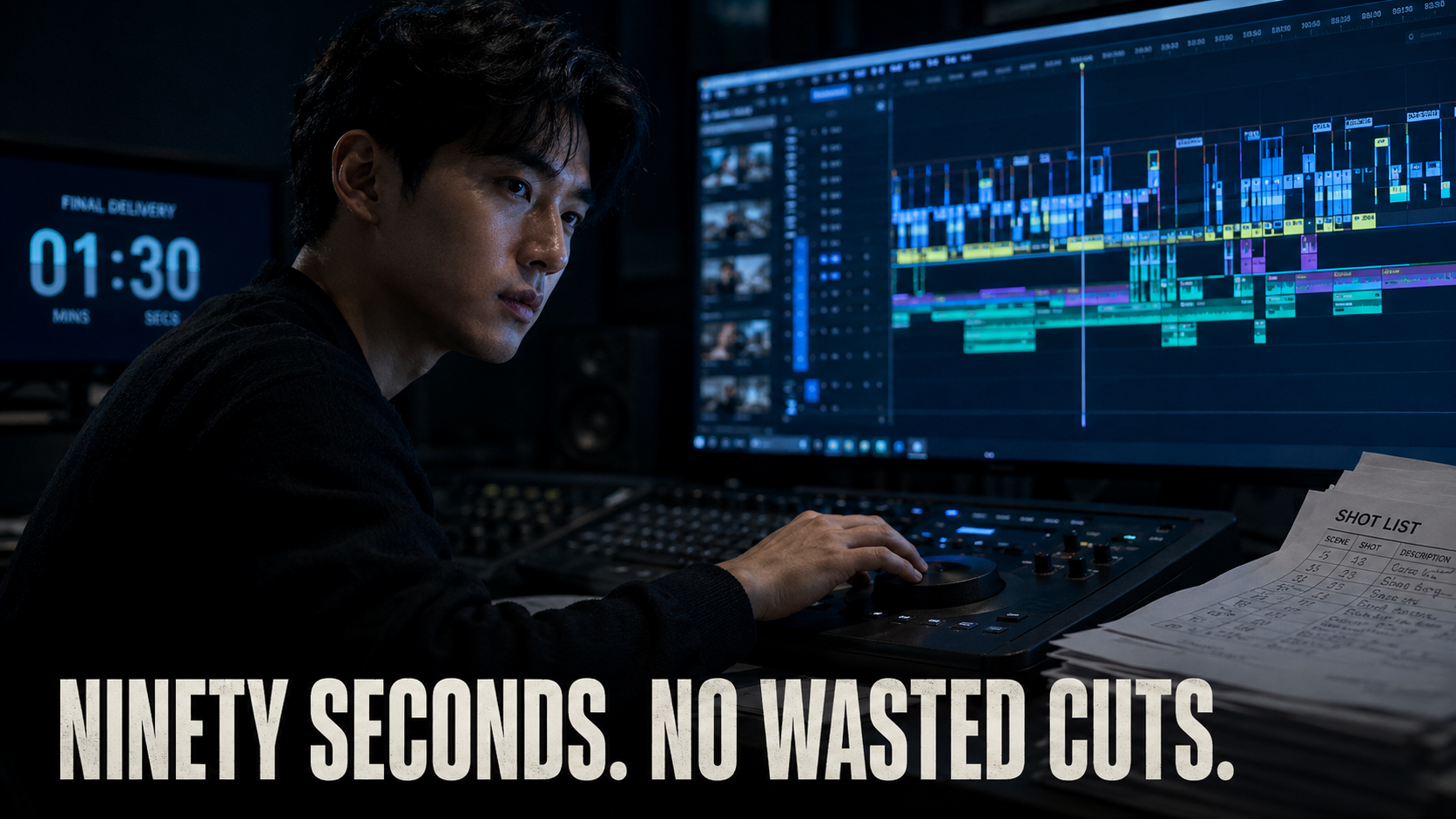
Pace should not be a decision made entirely in post. Each shot planned during scene development should carry an estimated duration, and the overall scene should be checked against the episode's target runtime before generation begins. A scene budgeted for 15 seconds that is written with five shots each needing three seconds to register will read as rushed. The fix happens at the shot list stage, either trimming shots or extending the scene's time budget, not by hoping the edit will somehow compress five ideas into fifteen seconds after the fact.
This also protects generation budget. Shots planned against a realistic time allocation are less likely to be discarded in the edit for running too long or too short, which means fewer wasted generation calls across a season and a tighter correlation between what gets generated and what actually ships in the final cut.
Pacing an episode against its hook structure
A well-paced 90 second episode typically front-loads its opening hook in the first three to eight seconds, spends the middle 60 to 70 seconds on two or three scenes that escalate stakes with progressively tighter cuts, and accelerates sharply into the final scene where the ending cliffhanger lands. Mapping this rhythm against the season's shot list before generation, rather than discovering the pacing problem during the edit, is what MinionArts Vertex's episode timeline view is built to catch, since duration fields on every shot node roll up into a running total against the episode's target length.
Reading pace against completion and drop-off data
Once episodes are live, completion rate and drop-off timestamps are the most direct evidence of whether a pacing decision worked. A sharp drop-off at a specific timestamp across multiple episodes in a season is usually a pacing signal before it is a story signal, an indication that a scene runs longer than the audience's attention will tolerate at that point in the episode, and adjusting future scene budgets in response to that data closes the loop between planned pacing and how an audience actually experiences it.
A worked example: pacing a full episode
A 90 second episode built around a betrayal reveal might budget its time like this. Zero to six seconds: the opening hook, a single tight shot with a line of dialogue that implies the betrayal without naming it. Six to forty seconds: two scenes establishing the relationship and the stakes, cut at a moderate pace with medium shots dominating. Forty to seventy seconds: the confrontation scene where the betrayal is confirmed, cutting faster between close-ups as the emotional temperature rises. Seventy to ninety seconds: the final scene, three short shots with hard cuts and no dialogue, ending on the image that becomes the episode's cliffhanger. The runtime is not divided evenly between scenes. It is divided according to where the story needs breathing room and where it needs acceleration, decided before a single shot generates.
Common pacing mistakes
The most common pacing mistake is giving every scene in an episode roughly equal runtime regardless of its narrative weight, which produces an episode that feels evenly paced in a way that reads as flat rather than balanced. A second common mistake is saving all acceleration for literally the final shot, which can make the preceding seventy or eighty seconds feel like a slow wait rather than a building sequence. The fix is treating pace as a curve that starts rising well before the final scene, so the audience feels momentum accumulating across the back half of the episode rather than experiencing a flat stretch followed by a sudden final jolt.
Pacing across a full season, not just one episode
Pacing decisions also compound across a season the way visual continuity does. A season where every episode follows an identical internal pacing curve, slow open, moderate middle, fast finish, in exactly the same proportions episode after episode, can start to feel formulaic to a viewer bingeing several episodes in a row, even if each individual episode is well paced on its own. Varying the internal rhythm occasionally, an episode that opens already mid-acceleration because the previous episode's cliffhanger demands immediate follow-through, or an episode that holds a slower opening because it is doing deliberate character work before its own escalation begins, keeps a season from settling into a pattern the audience can predict shot for shot. This is a season-level editing decision made when reviewing the full run of episodes together, not something any single episode's pacing plan can account for on its own.
Frequently Asked Questions
What is the most common transition type in microdrama editing? The hard cut, used for the majority of scene changes because it keeps the format's fast pace intact.
How long should a scene run in a 90 second episode? There is no fixed rule, but scenes approaching the episode's ending hook should run shorter, with tighter cuts, than scenes earlier in the episode establishing stakes.
Should pacing be planned before or after generation? Before. Estimated shot durations should be checked against the episode's target runtime during scene development, since fixing a pacing problem in the shot list is easier than fixing it after every shot is already generated.
When should a dissolve or fade be used instead of a cut? Rarely, and typically only for a time jump within an episode or at an episode's very end, since slower transitions work against the momentum the format depends on.
What is an audio-led cut? A transition where sound from the incoming scene begins slightly before the visual cut, pulling the viewer forward and disguising a transition that might otherwise feel slow.
How can completion data inform future pacing decisions? A sharp drop-off at a consistent timestamp across multiple episodes usually signals a pacing problem at that point in the runtime, and adjusting future scene time budgets in response closes the loop between planned pacing and audience behavior.
Pacing is a craft decision made at the shot list stage, not a fix applied in the edit bay. A microdrama episode that accelerates deliberately toward its hook, built from scenes budgeted for the right duration before a single shot generates, is what keeps a 90 second format from feeling either rushed or slow.