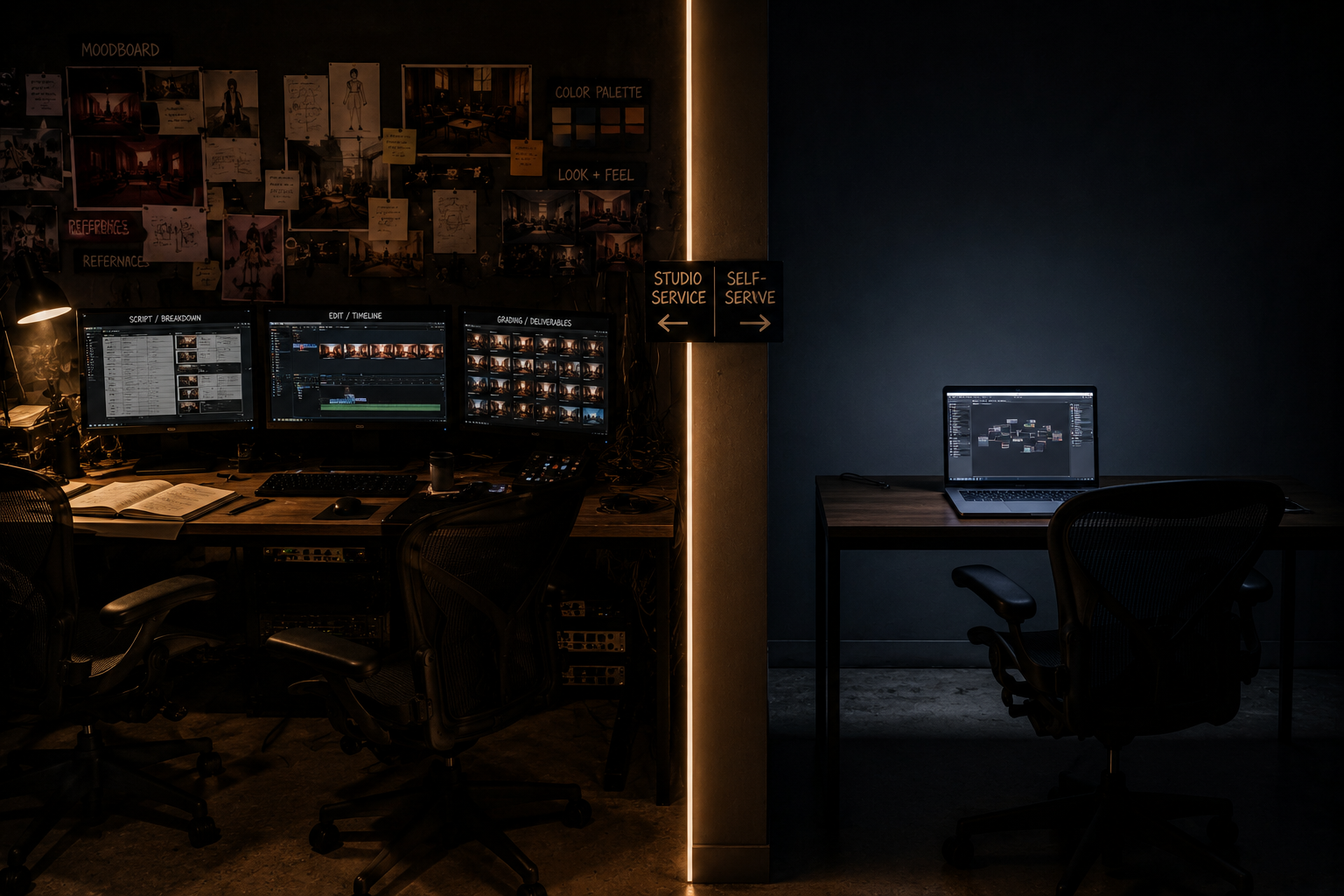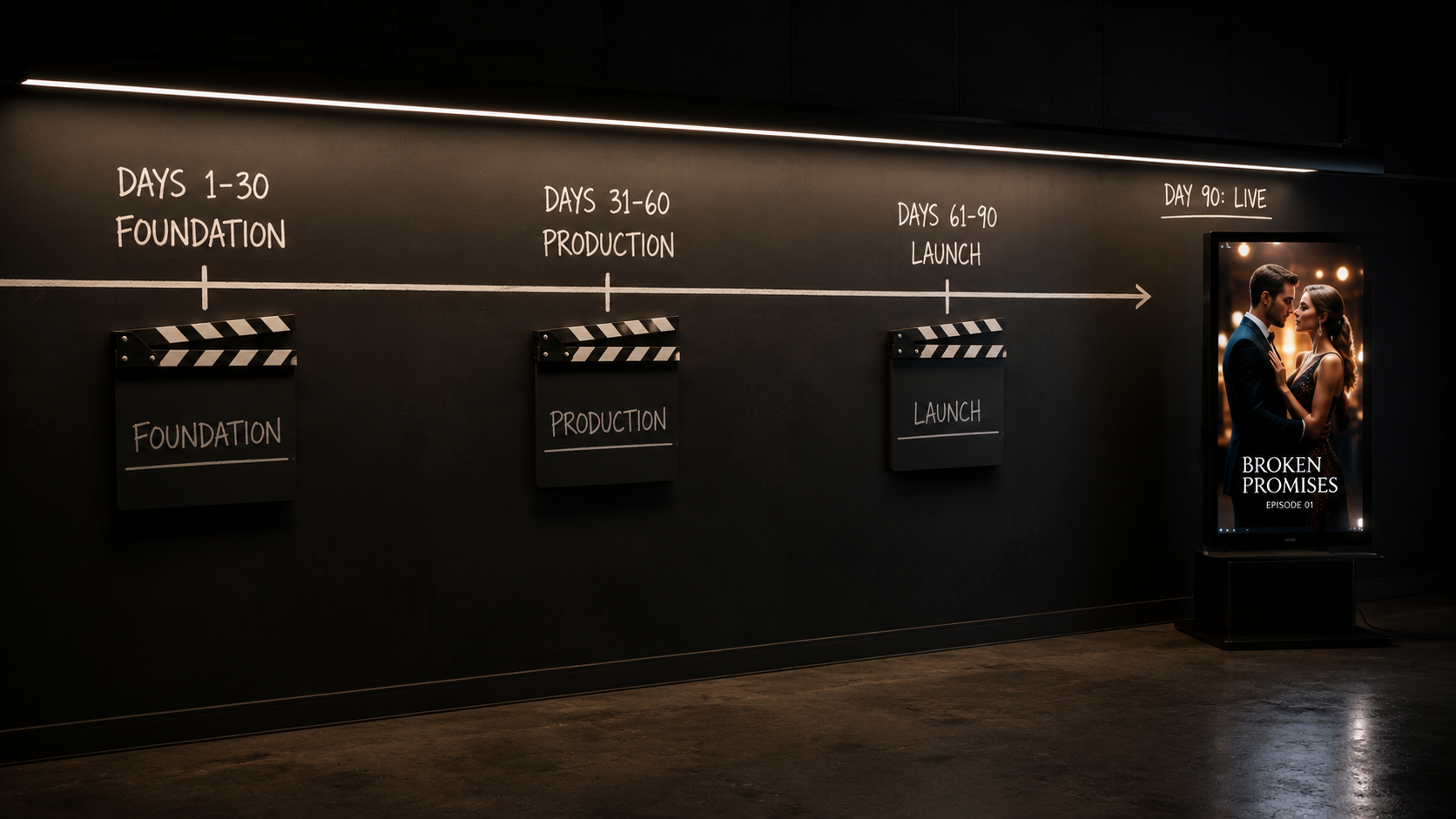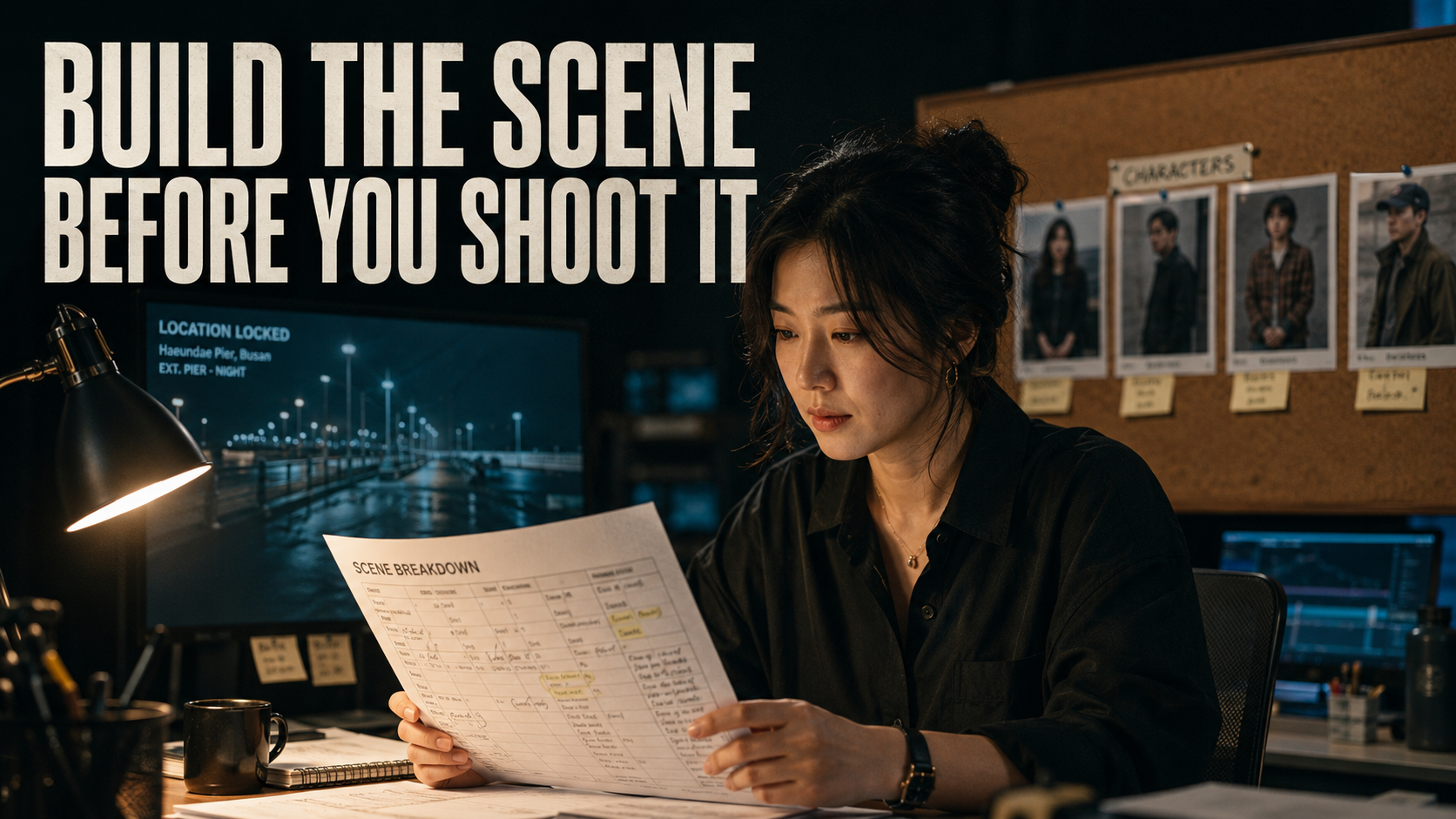
Scene development in AI microdrama production is the process of turning one script beat into a fully specified shot, meaning a locked location, a locked character state, a camera instruction, an emotional target, and a duration, before any generation model is ever called. In traditional filmmaking a director carries this translation in their head and on a shot list, refined across rehearsal and a physical location scout. In AI microdrama production it has to be written down in full, because the model has no memory of yesterday's set, no instinct for what the scene is supposed to feel like, and no ability to walk the room before it starts generating. Studios publishing 60 to 100 episode seasons in 2026 treat scene development as its own production stage, with its own deliverables and its own review pass, not a loose subset of writing or a side effect of generation.
Why scene development is a separate stage
A 90 second microdrama episode usually contains 5 to 9 scenes, and each scene runs 3 to 5 shots. That means a single episode script line like INT. PENTHOUSE - NIGHT, Mira confronts Daniel has to expand into a working document with the room described once, Mira and Daniel's wardrobe and physical state locked, the emotional temperature of the scene named, and a camera plan for how coverage moves across the beat. Skip this stage and generation becomes a guessing game: the model invents a different penthouse in shot two, drifts Mira's outfit in shot four, and the season loses the visual continuity that makes a vertical drama watchable.
The cost of skipping this stage is not visible until the season is assembled. Individual shots can look excellent in isolation and still fail as a sequence, because the viewer's brain is tracking spatial and visual continuity even when no one on the production team is. A studio generating 400 shots for a 60 episode season without a development stage is effectively asking an editor to catch and patch hundreds of small inconsistencies after the fact, which is slower and more expensive than deciding the four layers once, correctly, before generation starts.
The location and character layers
A properly developed scene carries four locked layers before it reaches a generation node. The first is the location layer: one written description of the set, covering architecture, lighting condition, time of day, and any set dressing that recurs across the scene, reused verbatim across every shot rather than re-described from memory each time a new shot is prompted. The second is the character layer: identity reference, wardrobe, and physical state for every character present in the beat, pulled directly from the season's character sheet rather than approximated. Wardrobe in particular needs to be locked at the scene level, not the episode level, since a character can change clothes between scenes within the same episode and that change has to be intentional rather than accidental drift.
Both layers exist to answer one question before generation starts: if this scene were shot on a physical set, what would already be true and fixed before the camera rolled. Writing that answer down removes the single largest source of visual inconsistency in AI-native production, which is not bad prompting on any individual shot, it is the absence of a shared reference that every shot in a scene is supposed to agree with.
The emotional and camera layers
The third layer is the emotional layer: a single word or short phrase naming what the scene needs to land, such as humiliation, reveal, or restraint, which steers dialogue delivery and camera choice together. This layer is easy to skip because it feels like something a director would intuit rather than write down, but in an AI pipeline nothing is intuited unless it is specified. A scene without a named emotional target tends to get shot the same generic way regardless of what is actually happening in the story, because there is no instruction anywhere in the pipeline telling the camera or the performance to behave differently.
The fourth layer is the camera layer: the shot list for the beat, which decides how the audience receives the emotional layer. This is where shot type, camera movement, and coverage get planned as a set rather than improvised shot by shot, and it is covered in depth in the companion pieces on camera angles and camera movement grammar. The camera layer should always be written after the emotional layer is named, not before, since the whole point of the shot list is to serve what the scene is trying to make the audience feel.
A worked example: from script line to developed scene
Take the script line from earlier: Mira confronts Daniel in the penthouse at night. A developed version of that beat looks like this. Location layer: a minimalist penthouse living room, floor to ceiling windows showing a city skyline at night, warm low lighting from two floor lamps, no overhead light on. Character layer: Mira in the black tailored coat established in episode three, standing near the window; Daniel in an unbuttoned white shirt, seated on the edge of a low sofa. Emotional layer: restrained fury, Mira holding back until the final line of the scene. Camera layer: open on a medium two-shot establishing the room, cut to alternating close-ups as the confrontation escalates, end on a slow push into Mira's face on her final line.
That is five sentences of planning that prevents dozens of possible drift errors across four to five generated shots. Every shot generated from this scene node inherits the same room, the same wardrobe, and the same emotional instruction, so the editor assembling the scene is working with material that was built to cut together rather than material that has to be forced to.
Scene development inside a node-based pipeline
On MinionArts Vertex, scene development happens as its own node cluster between the script node and the generation nodes. A scene node holds the four layers as structured fields rather than prose, so the location description, the character references, and the camera plan all feed downstream generation nodes as fixed inputs instead of being re-typed per shot. This is the difference between a workflow and a habit: a workflow keeps the penthouse the same penthouse in shot six as it was in shot one, because the location layer is a single field the whole scene points back to, not five separate prompts written by five separate people on five separate days.
This structure also makes revision cheap. If a note comes back that a scene's emotional target should shift from restrained fury to open confrontation, that change happens once at the scene node level, and every downstream shot regenerates against the updated instruction. Without a shared scene node, the same revision means manually re-editing four or five individual shot prompts and hoping none of them are missed.
Common scene development failures
Three failures show up repeatedly in microdrama seasons that skip this stage. Location drift, where a bedroom becomes a slightly different bedroom by episode three, usually because the location was described fresh each time rather than pulled from a locked reference. Wardrobe drift, where a character's signature outfit changes without story reason, which reads to viewers as a continuity error even when the plot has not actually moved. And emotional flattening, where every scene is shot the same way regardless of what the beat needs, because no one wrote down what the beat needed in the first place. All three are development failures, not generation failures. The model did exactly what it was told. It just was not told enough.
Scene development and season-length continuity
A single scene's development document matters on its own, but its real value shows up across a full season. A location layer written once for the penthouse in episode one should be the reference every future scene set in that penthouse pulls from, not a new description written from memory in episode nine. The same applies to character wardrobe states, which often change deliberately across a season, a promotion, a breakup, a disguise, and each change needs to be logged the same way the original state was. Studios running long seasons on Vertex maintain a location and character reference library alongside the season bible specifically so scene development for episode forty is pulling from the same locked sources as scene development for episode one.
Frequently Asked Questions
What is scene development in AI video production? Scene development is the stage where a script beat is expanded into a locked location, locked character state, emotional target, and camera plan before any shot is generated. It converts a single line of script into a structured reference every shot in the scene draws from.
Why does scene development matter more for microdrama than long-form film? A microdrama season generates thousands of individual AI shots across dozens of episodes, so any drift compounds fast. Long-form productions shoot on one physical set that cannot drift by definition, which is a form of continuity AI production has to recreate deliberately.
How long should a scene development document be? A single scene rarely needs more than four to six lines across the four layers. The goal is a fixed reference every shot in the scene can point back to, not a screenplay or a full production bible entry.
Where does scene development happen in a season production timeline? Between the locked script and the first generation pass, typically the same day a season bible is finalized and before any batch shot generation begins.
Who is responsible for scene development on a small AI microdrama team? On most lean teams it sits with whoever is functioning as showrunner or creative director, since it requires holding the full season's continuity in view rather than just the beat in front of them.
Does scene development slow down production? It adds time at the front of the pipeline but removes far more time from the back end, since fixing continuity errors after generation and editing is slower than preventing them with a locked reference before generation starts.
Scene development is the layer of microdrama production that decides whether a season looks like one continuous world or a series of disconnected renders. Studios that write it down before they generate anything ship seasons that hold together. Studios that skip it spend their editing time trying to fix continuity that should never have broken. MinionArts Vertex encodes scene development as a dedicated node cluster so the location, character, and camera decisions made once carry through every shot in the scene automatically.