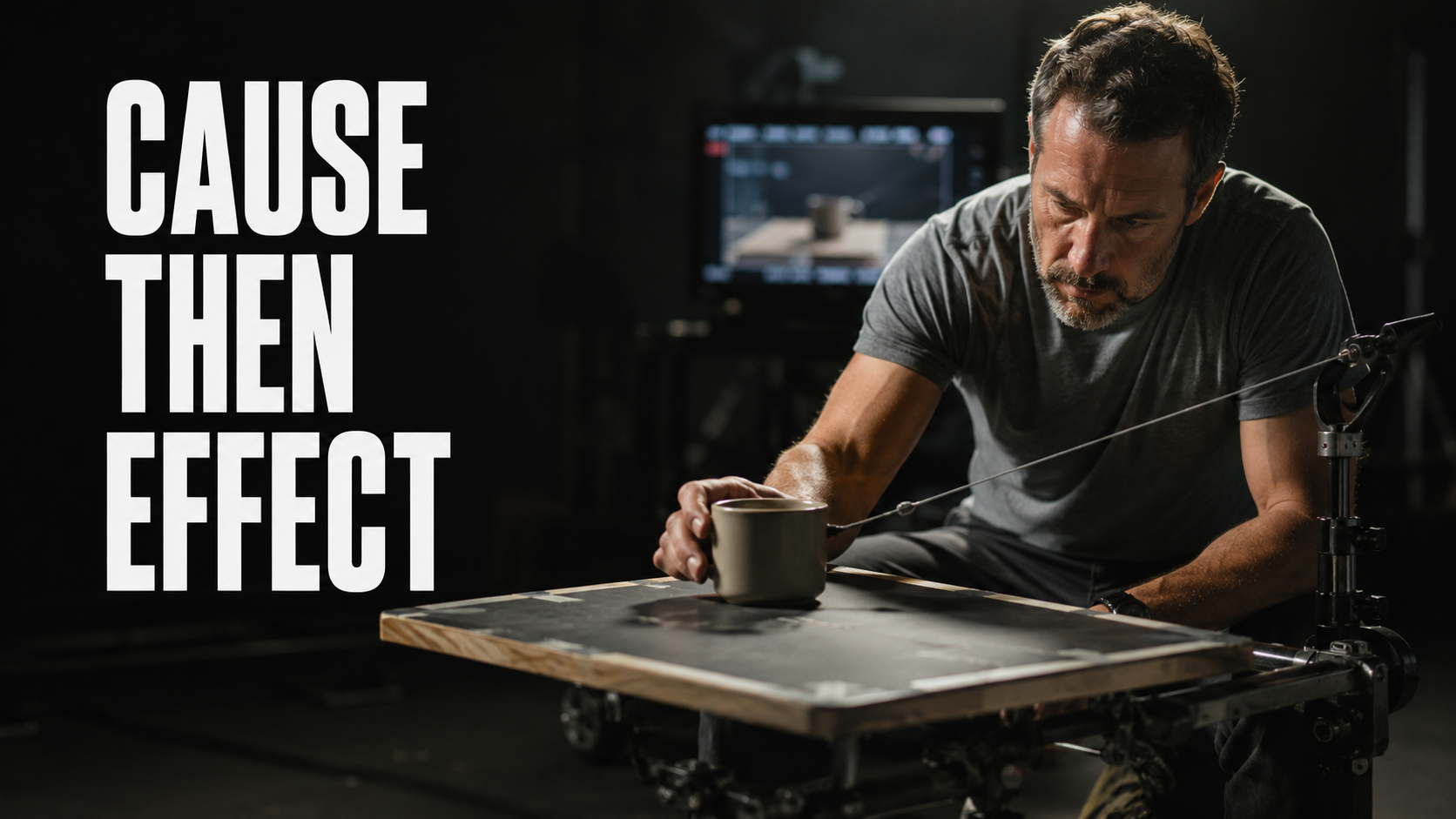
Believable physics in AI video comes from writing cause before effect, not from asking for realism. Models do not simulate mass. They predict what plausibly follows from what, which means a prompt that states an outcome without its cause forces the model to invent the middle. That invented middle is where floating debris, weightless impacts and rubbery limbs come from. Give the model the chain and it renders the chain.
This matters more in microdrama than in most formats, because the genre runs on physical beats: a slap, a shove, a dropped glass, a slammed door. Those beats have to land or the drama does not.
Why Outcome Prompts Fail
Consider the instruction: the glass shatters across the table. It names a result and nothing else. The model has to decide what broke the glass, where the force came from, and which direction the fragments travel. It will decide something, and it will usually decide that the glass simply ceases to be intact, with pieces expanding outward in a way that no impact would produce.
Now consider: the metal ball strikes the side of the glass. The glass fractures from the point of impact. Small pieces scatter across the wooden table while the heavier base tips onto its side.
Three sentences, one chain, one direction of force. The model has everything it needs to produce motion that obeys the same logic a viewer expects. Nothing in the second version asks for realism. It just supplies causality.
The Causal Chain Structure
Every physical beat can be written in the same three part shape.
The initiator. What applies force, and from where. A hand, a body, an object, gravity, wind.
The point of contact. Where the force meets the object, and what happens at that exact point.
The consequence. What travels, what falls, what settles, and in what order.
Order matters more than detail. A short chain in the right order beats a long description in the wrong one every time.
Materials Behave Differently, So Say Which
Fabric drags. Liquid pools and finds edges. Ceramic breaks into large pieces, glass into small ones. Paper flutters rather than falls. Hair carries momentum after the head stops moving. Models know these patterns, but only if the prompt identifies the material rather than the object.
Writing the coat swings is weaker than writing the heavy wool coat swings out and settles slowly against her legs. The second version names the mass, and mass is what governs how the motion decays.
Directing Human Impact Without Gore
Microdrama physical beats are usually interpersonal: a grab, a push, a hand caught mid air. These read badly when prompted as outcomes because the model produces contact without weight transfer. The fix is the same chain, applied to bodies.
Instead of he pushes her back, write: his palm meets her shoulder. Her weight shifts onto her back foot. She catches herself against the door frame before she recovers her stance.
Weight transfer is the tell. Once a body visibly redistributes its balance, the contact reads as real even at modest generation quality.
Worked Example: A Dropped Phone Beat
The beat is simple and appears in almost every microdrama season. A character receives news and drops her phone.
Outcome version. Shocked, she drops her phone and it clatters to the floor. Result: the phone tends to vanish from her hand and reappear on the floor, or it falls at an unconvincing speed with no bounce.
Chain version. Her fingers loosen. The phone slips from her hand, striking the edge of the coffee table first, then landing screen down on the rug. It does not bounce on the rug. She does not look at it.
The chain version specifies the release, an intermediate contact, the landing surface, and the behaviour of that surface. It also directs what does not happen, which is often as useful as what does. The last line, she does not look at it, is performance direction that only reads as intentional because the physical beat underneath it is legible.
Common Mistakes With Physical Beats
Asking for realistic physics as an adjective. The word realistic in a prompt does almost nothing. The chain does the work.
Skipping the initiator. Objects that move without a stated cause tend to move as if underwater.
Describing simultaneous events. If three things happen at once, the model has no order to follow. Stagger them even by a fraction.
Naming objects but not materials. A vase and a wooden bowl fall the same way to a prompt that says only bowl.
Over specifying fragment counts. Asking for exactly forty seven pieces of glass gives the model an arithmetic problem instead of a physical one.
Combining a physical beat with a camera change. Let the camera hold through an impact. Moving the frame during the moment of contact hides the very thing you engineered.
Directing Force Direction Explicitly
Force has a direction, and prompts that omit it produce motion that expands symmetrically outward, which is the single most recognisable tell of generated action. Stating where the force came from and where it goes fixes most of it.
She pulls the drawer toward her body and it stops hard against its stop, so the contents slide forward and settle. That sentence names the direction twice, once in the pull and once in the slide, and the model has no reason to invent a different vector.
Momentum and Settling
Motion that stops instantly reads as fake. Real objects overshoot, oscillate and settle, and how long that takes is governed by mass. Prompts almost never mention it, which is why generated motion so often arrives at a dead stop.
Direct the settle. The door swings shut, bounces slightly against the frame and comes to rest. Her hair keeps moving after she stops turning. The curtain falls back and continues to shift for a moment. These clauses are short and they do a disproportionate amount of realism work.
Scale Cues Prevent Miniature Syndrome
When physics look wrong at a glance but nothing specific is identifiable, the cause is often scale. Objects that move too fast for their size read as miniatures, which is a problem that plagued generated video through 2025 and 2026 alike. The fix is to give the model a size anchor: a hand next to the object, a known object in frame, or an explicit statement of weight.
The heavy steel door takes effort to move is a better instruction than the door opens slowly, because the first explains why and the second only describes what.
Directing Around the Hard Cases
Some physical beats remain genuinely difficult regardless of prompting skill. Large numbers of small fragments, complex fluid interaction, fine articulated hand work on small objects and crowd contact all degrade faster than other motion. The professional answer is not to keep regenerating. It is to redesign the shot.
Move the hard beat off screen and keep the reaction on screen. Cut to a tighter frame where fewer elements have to be resolved. Let the sound carry the impact. Show the aftermath rather than the event. These are the same choices low budget live action production has always made, and they work here for the same reason: the viewer completes the beat themselves, and their version is better than anything you would have generated.
Test Physical Beats in Isolation
A physical beat buried inside a full narrative take is hard to diagnose, because a failure could be coming from the action, the camera, the references or the beat itself. Testing it alone is faster and cheaper.
Generate the beat as a short standalone shot with a locked camera, no dialogue and no performance direction. If it reads correctly there, the chain is right and any problem in the full take is coming from somewhere else. If it does not, you have isolated the variable and can rewrite the chain without burning full length generations to find out.
Beats worth testing this way are the ones a scene depends on: the slap, the fall, the break, the door. Once a chain works, save the exact wording. A verified physical beat is a reusable asset, and the same three sentences will keep producing the same result across a season.
Frequently Asked Questions
Does causal prompting work for non action scenes?
Yes. Doors, chairs, curtains, poured drinks and set down cups all benefit. Any object interaction reads better with a stated cause, even in a quiet dialogue scene.
How long should a causal chain be?
Two to four clauses. Longer chains start competing with the rest of the take for the model attention and rarely improve the result.
Why do impacts still look soft even with a chain?
Usually because the prompt describes contact but not weight transfer. Add what shifts, what braces and what recovers.
Should I use slow motion for physical beats?
Sparingly. Slow motion exposes physics errors rather than hiding them. Use it once the beat already reads correctly at normal speed.
Do reference videos help with physics?
They help considerably when the model accepts motion references, because a clip carries timing and decay that words approximate poorly. Label it clearly as a motion reference so it is not read as a style or identity reference.
Can I direct off screen physical events?
Yes, and it is often cheaper and more effective. A sound and a reaction can sell an impact that never enters the frame, which sidesteps the hardest rendering problem entirely.
Start Directing Instead of Guessing
Every technique on this page gets easier when the take, the references and the continuity rules live in one place instead of scattered across tabs and text files. That is what Vertex is built for. Create a free account at MinionArts and start building your first microdrama scene today.