As of early 2026, Kling 3.0 and Seedance 2.0 are the two most capable AI video generation models available to production teams. They are not interchangeable. Kling 3.0 leads on physics simulation, native multilingual audio, and 4K resolution. Seedance 2.0 leads on multi-character scene consistency and multimodal reference input. The strongest production pipelines route different shot types to the model best suited for each.
Why Use Both Models
The production teams getting the best output in 2026 are not picking one model and using it for everything. Each model has a distinct performance profile across the variables that matter: character consistency, physics simulation, native audio, multi-shot control, and generation speed. Building a pipeline that routes by shot type rather than defaulting to one model produces measurably better output across a full production run.
Where Kling 3.0 Performs Best
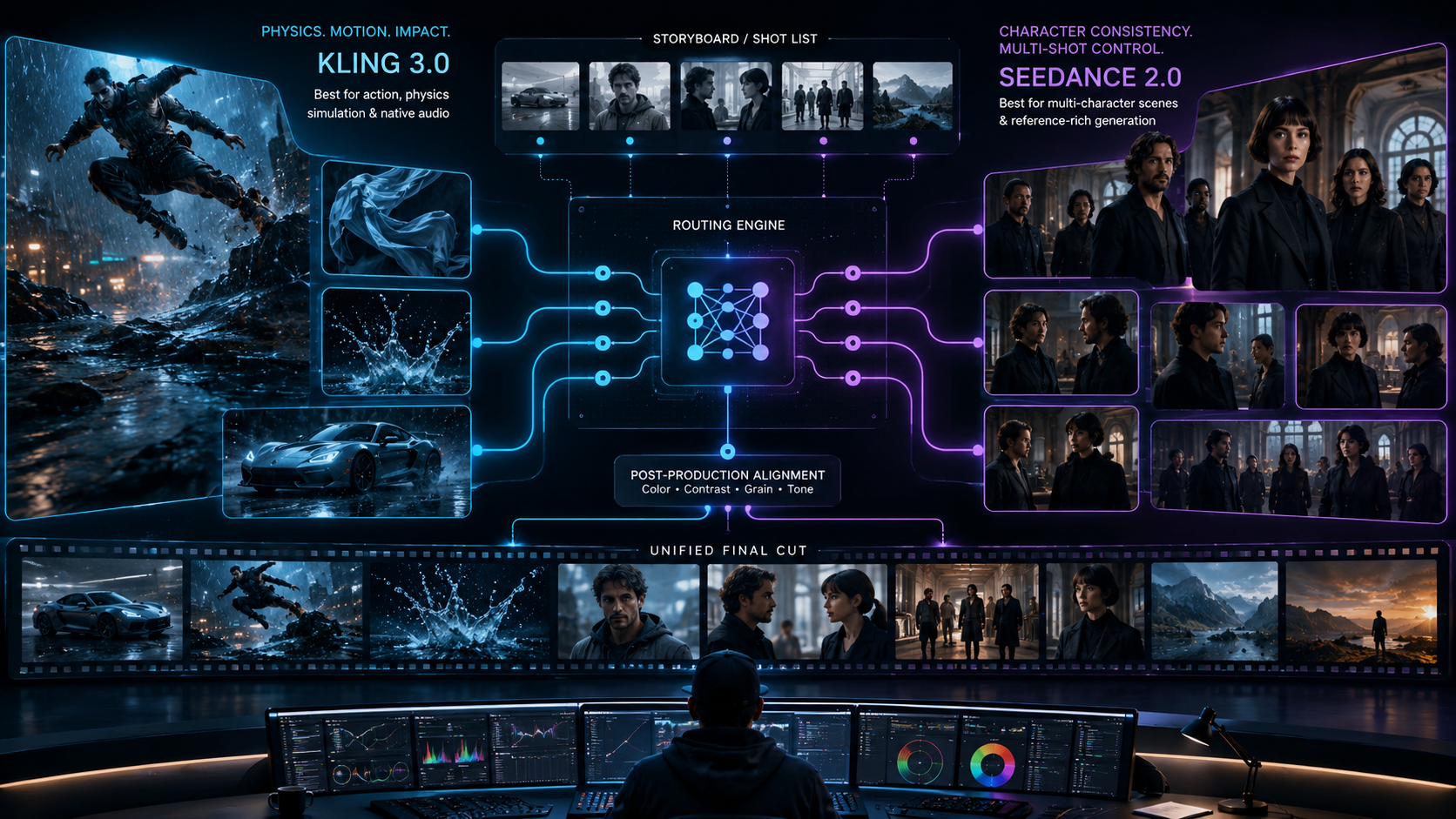
Kling 3.0 has a clear advantage in physics-intensive scenes. Its simulation of gravity, inertia, and fabric movement produces output where motion feels physically plausible rather than algorithmically generated. Action sequences, product demonstrations involving liquids or physical interactions, and fashion content with fabric movement are categories where Kling 3.0 produces measurably better output than most competing models currently available.
Kling 3.0 also has the advantage on native audio. For any scene requiring lip-synced dialogue or language-specific voice performance, Kling 3.0 generates this natively without an additional audio overlay step. For multilingual campaigns, this is a workflow simplification that adds up across a full production run.
Where Seedance 2.0 Performs Best
Seedance 2.0 has a strong advantage in multi-character scene consistency. Its reference-conditioned generation maintains individual character appearance across extended sequences more reliably than most competing models currently available. For narrative content with recurring characters, ensemble scenes, or any production requiring a defined cast across multiple shots, Seedance 2.0 is the more reliable choice.
Seedance 2.0 also performs well on reference-heavy briefs. The ability to combine up to 9 images, 3 video clips, and 3 audio files in a single generation makes it well-suited for precise visual direction requirements where multiple reference inputs must be synthesized into coherent output.
How to Build the Routing Logic
In a node-based workflow canvas, routing between Kling 3.0 and Seedance 2.0 is built as conditional logic at the shot level. Each shot in the storyboard carries a shot-type tag: action, dialogue, product demonstration, ensemble, or transition. Action and product shots route to Kling 3.0. Dialogue and ensemble shots route to Seedance 2.0. Transition shots route to either depending on the visual requirement.
This routing logic runs automatically once configured. A production run with 20 shots across both models executes concurrently, with all outputs arriving in the review queue simultaneously rather than sequentially.
Post-Production Alignment
When output comes from two different models, visual inconsistency in the final cut is a real risk. Kling 3.0 and Seedance 2.0 have different baseline aesthetics: different color treatment, contrast characteristics, and grain profiles. A color grading node in the post-production stage of the pipeline should apply unified treatment across all output before assembly. This alignment step is the difference between a final cut that reads as a coherent piece of visual work and one that reads as a compilation of clips from different sources.