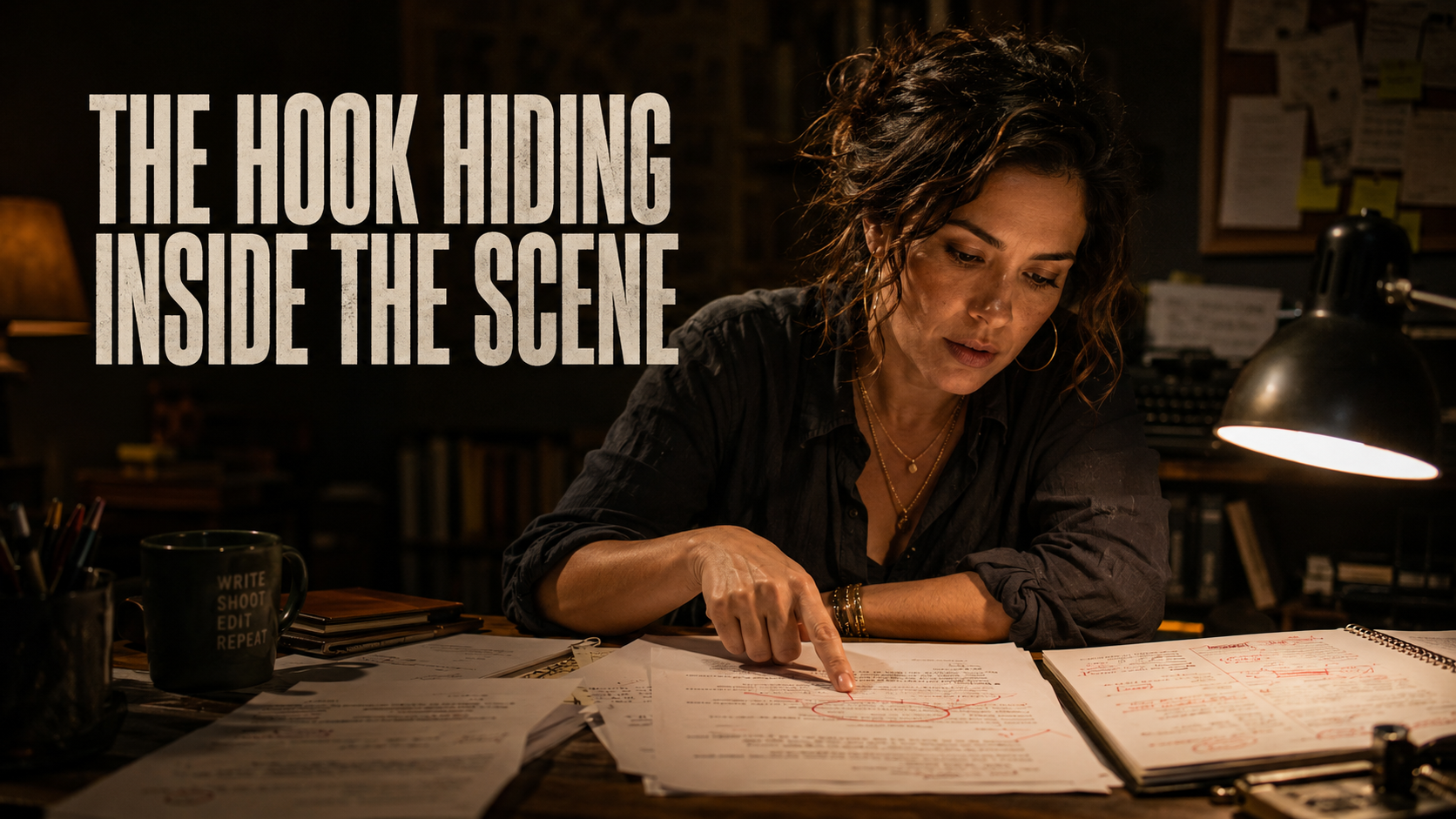
In-scene hooks are small tension devices placed inside individual beats of a microdrama, distinct from the episode-opening hook that has to land in the first eight seconds. Most microdrama content strategy focuses entirely on the opening hook, because that is what determines whether a viewer keeps watching past the first frame. But a 90 second episode still has to hold attention for the other 82 seconds, and that retention is built scene by scene through smaller hooks planted inside the dialogue and blocking of each beat, not by the opening hook's momentum alone.
What an in-scene hook actually is
An in-scene hook is any moment inside a beat that creates a small unresolved question the viewer wants answered before the scene ends. It can be a line of dialogue that implies more than it states, a reaction shot that shows a character knows something the audience does not yet, or a prop introduced without explanation that the audience registers and expects to matter later. The mechanism is the same one that makes episode-ending cliffhangers work, the Zeigarnik effect, where unfinished information creates more mental pull than finished information, just applied at a smaller scale inside a single scene rather than at the boundary between episodes.
The distinction matters because the two hook types are built differently. An episode hook is engineered to be unmissable in a few seconds of scrolling attention. An in-scene hook can be quieter, since the viewer is already watching and does not need to be stopped from leaving, only kept from drifting.
Where in-scene hooks belong in a scene's structure
A scene with three to five shots typically has room for one in-scene hook, placed either at the midpoint or just before the final shot. Placed at the midpoint, the hook resets attention that may have drifted during the opening beats of the scene, functioning as a small jolt that re-earns focus halfway through. Placed just before the final shot, it functions as a mini cliffhanger that carries momentum into the next scene even when the episode itself has not reached its ending hook yet, effectively chaining scene-to-scene tension across the full runtime rather than saving all of it for the final frame.
Placing more than one hook per scene tends to dilute both, since the viewer cannot track two open questions inside a beat that only runs a few seconds. A scene trying to plant two hooks usually ends up landing neither clearly, which reads as narrative clutter rather than layered tension.
Writing in-scene hooks that pay off
The discipline that separates a working in-scene hook from a cheap tease is payoff. Every hook planted inside a scene needs to resolve somewhere in the episode, either later in the same scene, in the next scene, or by the episode's final cliffhanger. A hook that never pays off reads as a continuity error rather than tension on a second watch, and vertical drama audiences do rewatch scenes to catch details they suspect they missed. The season bible should track every in-scene hook planted per episode against where it resolves, the same way it tracks character arcs, so nothing planted is accidentally dropped as episodes get produced in batches.
A useful pattern is grading hooks by how far their payoff sits from the plant. A short-range hook resolves within the same scene, which is the safest option for a fast-moving 90 second format. A mid-range hook resolves by the end of the episode. A long-range hook, reserved for major story turns, might not resolve for several episodes, and should be used deliberately rather than accidentally, since an audience that forgets a long-range hook was ever planted experiences its payoff as confusing rather than satisfying.
In-scene hooks and camera choice work together
The camera carries the hook as much as the dialogue does. A reaction shot held a beat longer than expected signals to the viewer that something registered without a line of dialogue confirming it. A cut away from a conversation just as a name is about to be said plants the hook visually rather than verbally. A slow push into an object the dialogue never mentions tells the viewer to remember it without a single word of exposition. Studios building scenes on MinionArts Vertex write the hook placement into the scene's shot list directly, so the close-up or the cutaway that carries the hook is planned as part of the camera layer rather than decided during editing, when it is much harder to insert.
In-scene hooks across genre
The right density and style of in-scene hook shifts by genre. Revenge and thriller formats tend to support a hook in nearly every scene, since the genre's whole appeal runs on continuous suspense. Romance formats often work better with fewer, more emotionally loaded hooks, a held glance, an unfinished sentence, since the genre's tension is relational rather than plot-driven and too many hooks can make a romance feel more like a mystery than a love story. Matching hook density to genre expectation is part of what keeps a season feeling tonally consistent across its episodes.
A worked example: planting and paying off a hook
In a scene where two characters discuss a business deal, an in-scene hook can be planted through a single visual beat: as one character reaches for a folder on the desk, the camera holds a half second longer than needed on a second, unlabeled folder sitting just beneath it. No dialogue calls attention to it. A viewer who is paying attention registers that something is being deliberately not discussed. The payoff can land two scenes later, when that second folder reappears in a different character's hands, confirming the audience's suspicion was correct. The entire mechanism costs one held reaction shot and one later insert, and it does more to keep a viewer alert through a slower dialogue scene than any change to the dialogue itself would.
Common in-scene hook mistakes
The most common failure is treating every scene as needing a hook, which produces a season where nothing feels ordinary and, paradoxically, nothing feels tense either, since constant escalation has no baseline to escalate from. A second common failure is planting a hook so quietly that it fails to register with a first-time viewer, then relying on the payoff scene to explain it after the fact, which reads as a plot twist invented late rather than a hook that was planned. The safest correction for both is the season bible discipline described above: track every planted hook and its intended payoff scene at the time the hook is written, not after the season is already in production.
In-scene hooks and AI generation constraints
Not every hook idea translates cleanly to a generated shot, and that constraint is worth planning around rather than discovering during production. A hook built entirely around a subtle facial micro-expression, a flicker of recognition held for a fraction of a second, is harder to get consistently right from a generation model than a hook built around a clearer visual device, an object, a framing choice, a held reaction of a full second or more. Writers building hook-heavy scenes for AI production benefit from favoring the second category, since it is more reliably generated across multiple attempts and does not depend on the model nailing an extremely subtle performance detail on the first pass. This is not a creative limitation so much as a practical one: a hook the audience cannot clearly read because the generated expression came out ambiguous fails at its one job, regardless of how well it was written on the page.
Frequently Asked Questions
What is the difference between an in-scene hook and an episode hook? An episode hook opens or closes a full episode and has to land in seconds. An in-scene hook is smaller, sits inside a single beat, and sustains attention through the middle of an episode rather than at its edges.
How many in-scene hooks should one scene have? Typically one, placed at the scene's midpoint or just before its final shot. More than one per scene tends to dilute the effect and read as clutter.
Do in-scene hooks need to be resolved? Yes. An unresolved in-scene hook reads as a continuity gap rather than tension, especially on a rewatch, so every hook should be tracked to a payoff point in the season bible.
Can an in-scene hook be purely visual? Yes. A held reaction shot, a cutaway before a reveal, or an unexplained prop can all function as hooks without a line of dialogue.
How far apart can a hook and its payoff be? Short-range hooks resolve within the same scene, mid-range within the episode, and long-range hooks may span several episodes, but long-range hooks should be used deliberately and sparingly so the audience does not forget they were planted.
Does hook density change by genre? Yes. Thriller and revenge formats tend to support a hook in nearly every scene, while romance formats often work better with fewer, more emotionally loaded hooks.
Retention across a 90 second episode is not decided by the opening hook alone. It is built beat by beat through smaller tension devices planted and paid off inside individual scenes. Writing those hooks into the scene's shot list, rather than hoping the edit finds them, is what keeps a viewer through the full runtime instead of just the first eight seconds.