The Language of Generative Filmmaking: 25 Terms Every Modern Creator Should Know
Why Every Creator Needs to Speak This Language
Generative filmmaking has developed its own vocabulary at the intersection of storytelling, cinematography, artificial intelligence, and creative production.
If you are building content with AI, designing production workflows, creating films, generating ads, or operating inside modern creative platforms like MinionArts, fluency in this language is becoming a professional baseline.
Just as filmmakers learned lenses, frame rates, lighting, and editing terminology, creators today must understand concepts like temporal consistency, image-to-video generation, node-based workflows, agentic production, and character drift.
These terms are no longer reserved for engineers.
They are becoming the language of modern visual storytelling.
This glossary covers the most important concepts shaping AI-native production in 2026.
Core Generation Concepts
Text-to-Video (T2V)
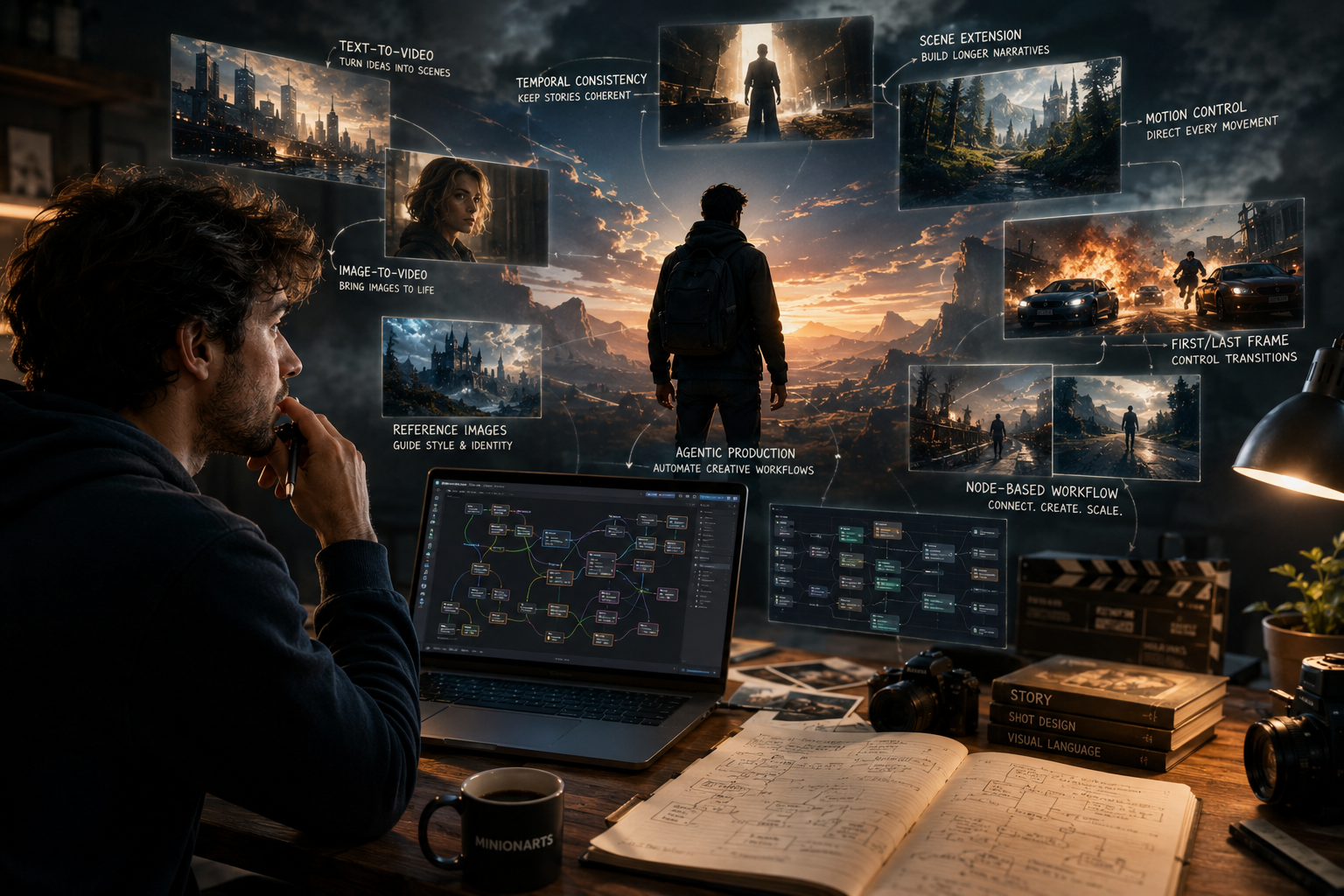
The generation of video clips directly from natural language prompts.
Text-to-video models transform written instructions into moving visuals, allowing creators to describe scenes, camera movements, characters, and actions without traditional filming.
Example:
"A cinematic drone shot flying over a futuristic city at sunrise."
Image-to-Video (I2V)
The animation of a static image into a video sequence.
Image-to-video workflows provide stronger control over character identity, product appearance, environments, and visual style compared to text-only generation.
For narrative filmmaking and branded content, image-to-video is often the preferred starting point.
Latent Space
A compressed representation of visual information used by AI models during generation.
Instead of creating every pixel directly, modern AI systems operate within a mathematical representation of images and video, making high-quality generation computationally feasible.
Diffusion Model
A class of AI model that generates images and video by gradually transforming random noise into structured visual content.
Most modern image and video generation systems are built on diffusion-based architectures.
Temporal Consistency
The degree to which visual elements remain stable across frames.
High temporal consistency means characters, clothing, objects, and environments remain coherent throughout a sequence.
Low temporal consistency often produces flickering, morphing, or identity changes.
For narrative filmmaking, temporal consistency is one of the most important quality metrics.
Prompt Adherence
The accuracy with which a model follows instructions provided by the creator.
High prompt adherence means the generated result closely matches the requested scene, style, camera movement, and creative intent.
Reference Image
An image provided to guide generation.
Reference images can be used to preserve:
Character identity
Product appearance
Environment design
Visual style
Composition
Reference-based workflows have become essential for professional production.
Cinematography Terms in the AI Era
Dolly In
A camera movement where the camera physically moves toward the subject.
In AI filmmaking, creators specify this movement directly in prompts.
Example:
"Slow cinematic dolly in toward the character."
Dolly Out
The opposite of a dolly in.
The camera gradually moves away from the subject, often used to reveal scale, environment, or emotional isolation.
Push-In Shot
A subtle forward camera movement used to create intimacy and emotional emphasis.
Frequently used during dialogue and dramatic moments.
Orbit Shot
A camera move where the camera circles around a subject while maintaining focus.
Often used for cinematic reveals and hero moments.
Rack Focus
A shift in focus from one subject to another within the same shot.
Example:
Foreground character sharp → Background product sharp.
This technique helps direct audience attention.
Depth of Field
The amount of a scene that appears in focus.
Shallow depth of field creates cinematic subject separation.
Deep depth of field keeps more of the environment visible.
Anamorphic Look
A cinematic visual style characterized by:
Horizontal lens flares
Wide aspect ratios
Compressed perspective
Filmic aesthetics
Frequently used in high-end commercial and narrative production.
Workflow and Production Terms
Node-Based Workflow
A production architecture where each creative operation is represented as a visual node.
Examples include:
Image Generation
Video Generation
Voice Generation
Music Creation
Editing
Publishing
Nodes are connected together to create repeatable production systems.
Vertex
MinionArts' node-based production canvas.
Vertex allows creators to visually connect creative operations into reusable workflows that can generate images, videos, voiceovers, music, and finished deliverables.
Instead of manually moving between tools, creators build systems that execute production logic automatically.
Workflow Template
A reusable production system designed for a specific outcome.
Examples include:
Product advertisements
UGC videos
Fashion campaigns
Storytelling sequences
Explainer videos
Templates reduce production time while maintaining consistency.
JSON Pipeline
A structured representation of a workflow containing:
Nodes
Parameters
Connections
Model selections
Production logic
JSON pipelines enable workflows to be reused across multiple projects.
Agentic Production
A production system where AI agents make decisions and execute tasks autonomously within defined constraints.
Rather than manually performing every step, creators supervise systems that execute production processes on their behalf.
Production Infrastructure
The combination of workflows, templates, agents, models, and creative systems that allow content production to operate at scale.
Modern creators increasingly rely on production infrastructure rather than individual tools.
Creative Agent
An AI system capable of planning, coordinating, and executing multi-step creative tasks.
Creative agents can generate assets, select workflows, optimize outputs, and manage production processes while operating under human direction.
Video Generation Concepts
Scene Extension
A workflow technique where the final frames of one clip become the visual anchor for generating the next clip.
Scene extension enables creators to build long-form narratives while preserving continuity across multiple generations.
First/Last Frame Control
A generation technique where creators provide both a starting image and an ending image.
The AI generates motion between these two states while preserving visual coherence and narrative flow.
Motion Control
The process of defining how subjects, objects, cameras, or environments move throughout a generated scene.
Strong motion control produces more intentional and cinematic results.
Camera Path
A predefined movement trajectory for a virtual camera.
Examples:
Dolly In
Dolly Out
Orbit
Crane Up
Tracking Shot
Camera paths help create more professional-looking video sequences.
Quality and Evaluation Terms
Usable Take Rate
The percentage of generated clips that meet the quality threshold required for production.
A higher usable take rate means less regeneration, lower costs, and faster workflows.
Character Drift
The tendency for a generated character to gradually change appearance across scenes.
Character drift may affect:
Facial structure
Hair
Clothing
Body proportions
Accessories
Reducing character drift is one of the primary challenges of AI-native filmmaking.
Visual Hallucination
The generation of visual elements that were not requested by the creator.
Examples include:
Extra fingers
Incorrect objects
Distorted text
Unexpected background elements
Hallucinations are often reduced through stronger references and workflow design.
Identity Consistency
The ability to maintain the same character appearance across multiple images and video clips.
Identity consistency is essential for storytelling, advertising, and branded content.
Style Consistency
The ability to preserve the same visual aesthetic across an entire production.
This includes:
Lighting
Color grading
Camera language
Environment design
Character presentation
Cinematic Preset
A predefined collection of visual settings that automatically applies a particular aesthetic.
Examples include:
Film Noir
Golden Hour
Luxury Commercial
Documentary
Sci-Fi
Editorial Fashion
Presets accelerate creative production while maintaining consistency.
Frequently Asked Questions
What is generative filmmaking?
Generative filmmaking is the practice of creating films, advertisements, visual stories, and video content using AI generation as the primary production method.
Instead of relying entirely on physical cameras, sets, actors, and crews, creators use AI systems to generate visuals, motion, voice, music, and sound while focusing on direction, storytelling, and creative decision-making.
What is the difference between generative filmmaking and AI-assisted filmmaking?
AI-assisted filmmaking uses AI to enhance parts of a traditional production workflow.
Generative filmmaking uses AI as the primary engine responsible for creating the visual content itself.
The human creator operates as director, storyteller, editor, and curator.
Why should creators learn these terms?
Traditional filmmaking required understanding cameras, lenses, lighting, editing, and production workflows.
Generative filmmaking requires understanding prompts, temporal consistency, identity preservation, node-based workflows, motion control, and AI production systems.
These concepts are becoming the grammar of modern visual storytelling.
The creators who learn this language can move from idea to finished film faster than ever before.
The creators who ignore it will struggle to direct increasingly intelligent production systems.
Understanding these terms is no longer a technical advantage.
It is becoming a creative requirement.
Final Thoughts
Every technological shift creates a new language.
The rise of cameras created cinematography.
The rise of computers created digital editing.
The rise of AI is creating generative filmmaking.
The tools will continue to evolve.
The models will continue to improve.
But the creators who understand the language behind them will always have the greatest advantage.
Learning these concepts today is not about keeping up with technology.
It is about learning how the next generation of stories will be created.