Flux Kontext vs Runway Gen-4.5: Which Is Better for Cinematic AI Content in 2026?
If you're creating AI-generated films, advertisements, storyboards, product visuals, or social media content, you've probably encountered the same question:
Should you use Flux Kontext or Runway Gen-4.5?
The answer depends entirely on what you're trying to create.
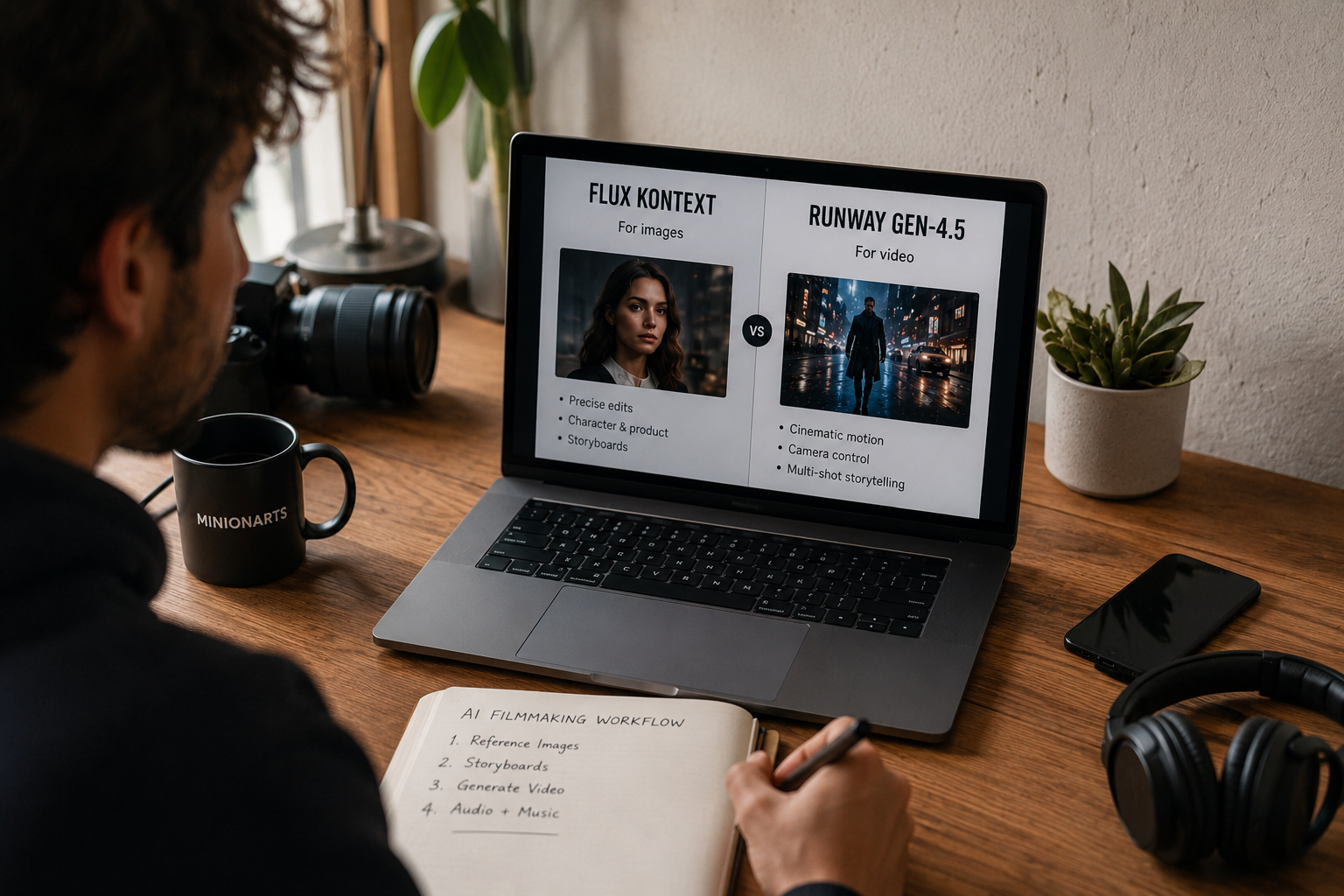
If your goal is creating highly controlled cinematic still images, product shots, character references, and storyboards, Flux Kontext is the stronger tool.
If your goal is generating cinematic motion, camera movements, narrative sequences, and finished video content, Runway Gen-4.5 is the stronger tool.
The reality is that most professional AI production workflows use both.
Flux Kontext creates the visual foundation.
Runway brings that foundation to life through motion.
In this guide, we'll break down where each tool excels, how professional creators use them together, and what the optimal AI filmmaking workflow looks like in 2026.
Quick Answer: Flux Kontext vs Runway
Category | Flux Kontext | Runway Gen-4.5 |
|---|---|---|
Image Generation | Excellent | Good |
Image Editing | Excellent | Limited |
Storyboards | Excellent | Good |
Character References | Excellent | Good |
Product Visualization | Excellent | Moderate |
Video Generation | No | Excellent |
Camera Movement | No | Excellent |
Narrative Storytelling | No | Excellent |
Multi-Shot Sequences | No | Excellent |
Motion Control | No | Excellent |
The Short Version
Choose Flux Kontext if you need:
Storyboards
Product visuals
Character references
Concept art
Image editing
Style exploration
Choose Runway if you need:
Cinematic videos
AI films
Character animation
Narrative storytelling
Camera movement
Motion control
Professional creators typically use both.
What Is Flux Kontext?
Flux Kontext is an image generation and image editing model developed for precise instruction-following visual creation.
Its biggest strength is control.
Unlike traditional image generators that often reinterpret prompts creatively, Flux Kontext excels at making targeted changes while preserving the rest of the image.
This makes it particularly valuable for professional production environments where consistency matters.
Common Flux Kontext Use Cases
Character Development
Creators generate multiple versions of the same character while preserving:
Face structure
Clothing
Accessories
Visual identity
This becomes essential for narrative projects where characters appear across multiple scenes.
Product Advertising
Brands use Flux Kontext to create:
Product photography
Lifestyle scenes
Packaging concepts
Campaign visuals
while maintaining accurate materials, textures, colors, and branding.
Storyboard Creation
Before generating video, creators often build storyboards.
Flux Kontext allows teams to rapidly explore:
Camera angles
Lighting setups
Environment designs
Character placement
without the cost and time associated with video generation.
Visual Development
Many filmmakers use Flux Kontext as a pre-production tool.
Instead of immediately generating video, they first develop:
Mood boards
Key frames
Character sheets
Environment concepts
This dramatically improves downstream video quality.
What Is Runway Gen-4.5?
Runway Gen-4.5 is a video generation system focused on cinematic motion, narrative storytelling, and character consistency.
Where Flux Kontext specializes in creating images, Runway specializes in bringing those images to life.
Its primary value lies in generating believable movement while maintaining visual coherence.
Common Runway Use Cases
Narrative Video Creation
Runway is widely used for:
Short films
Commercials
Social media videos
Music videos
Brand storytelling
where motion is the primary output.
Cinematic Camera Movement
Creators can specify directorial instructions such as:
Dolly in
Dolly out
Orbit shot
Tracking shot
Crane movement
allowing generated footage to feel closer to traditionally filmed content.
Character Animation
Runway can animate previously generated character references into moving sequences.
This makes it valuable for:
AI-native films
Character-driven advertising
Digital influencers
Social content
Multi-Shot Storytelling
One of Runway's strongest capabilities is maintaining continuity across multiple scenes.
This enables creators to build:
Story sequences
Commercial narratives
Character journeys
rather than isolated video clips.
Is Flux Kontext Better Than Runway?
No.
They solve different problems.
Comparing Flux Kontext and Runway is similar to comparing storyboarding software and a camera.
One helps define the vision.
The other helps capture motion.
If your output is a still image, Flux Kontext often provides more control.
If your output is a video, Runway becomes significantly more valuable.
Most professional workflows use both.
Can Flux Kontext Create Videos?
No.
Flux Kontext is an image model.
It generates and edits images but does not generate video sequences.
Many creators use Flux Kontext to create reference images that are later animated using video generation systems.
This workflow produces significantly more consistent results than generating video from text prompts alone.
Is Runway Better for AI Filmmaking?
For motion and narrative storytelling, yes.
Runway is specifically designed around video generation.
Its strengths include:
Motion generation
Character animation
Camera control
Multi-shot storytelling
Narrative consistency
However, most successful productions still begin with image development before entering video generation.
The strongest AI films rarely start with video.
They start with visual planning.
Flux Kontext vs Runway for Storyboards
Storyboards are one of the most important stages of modern AI filmmaking.
They allow creators to establish:
Character identity
Scene composition
Lighting direction
Narrative flow
Camera placement
before investing in video generation.
For storyboards, Flux Kontext is generally the stronger option.
Its ability to make precise adjustments enables rapid iteration without losing visual consistency.
Flux Kontext vs Runway for Product Advertising
For product advertising, Flux Kontext is usually the better starting point.
Brands need:
Material accuracy
Lighting control
Product consistency
Brand fidelity
These requirements align closely with Flux Kontext's strengths.
After approval, those visuals can be converted into motion assets using video generation workflows.
Flux Kontext vs Runway for Character Consistency
Character consistency remains one of the biggest challenges in AI filmmaking.
Creators need characters to remain recognizable across:
Images
Scenes
Locations
Camera angles
Video sequences
Flux Kontext excels at creating consistent character references.
Runway excels at animating those references.
Used together, they create a significantly more reliable workflow.
The AI Filmmaking Workflow Used by Professional Creators
The highest-performing AI production teams rarely rely on a single tool.
Instead, they use a workflow.
The process generally follows four stages.
Stage 1: Visual Development
The first step is creating:
Characters
Products
Environments
Mood frames
The objective is visual consistency.
At this stage, creators focus on aesthetics rather than motion.
Stage 2: Storyboarding
Next comes storyboard creation.
Storyboards define:
Scene order
Camera angles
Lighting
Narrative pacing
This stage reduces production uncertainty and improves final output quality.
Stage 3: Motion Generation
Once key frames are approved, creators generate motion.
This stage includes:
Character animation
Camera movement
Scene transitions
Narrative execution
Motion generation transforms static concepts into cinematic sequences.
Stage 4: Voice, Music and Sound Design
The final stage includes:
Dialogue
Voiceovers
Music
Sound effects
Audio mixing
This is where the project evolves from a visual sequence into a finished piece of content.
How MinionArts Approaches AI Filmmaking
Modern AI production is no longer about using individual tools.
It is about connecting them.
MinionArts approaches filmmaking as a workflow problem rather than a model problem.
Using Vertex, creators can connect:
Image generation
Image editing
Video generation
Voice synthesis
Music creation
Publishing workflows
inside a single node-based production canvas.
Instead of manually moving assets between multiple applications, creators build reusable production systems that can generate:
AI advertisements
Product videos
UGC content
Brand campaigns
Social media assets
Narrative films
at scale.
The goal is not simply generating content.
The goal is building production infrastructure.
Frequently Asked Questions
Which is better for cinematic shots?
For still images, Flux Kontext generally provides more control.
For moving cinematic sequences, Runway is the stronger option.
Which is better for product marketing?
Flux Kontext is typically the better starting point because of its precision and image editing capabilities.
Which is better for AI filmmaking?
Runway is stronger for motion generation and storytelling.
However, most successful AI films begin with image creation and storyboarding before entering video production.
Should I use Flux Kontext or Runway?
Use Flux Kontext when you need:
Storyboards
Product visuals
Character references
Image editing
Use Runway when you need:
Motion
Video
Character animation
Narrative sequences
For professional production workflows, using both is often the most effective approach.
Final Thoughts
The question isn't whether Flux Kontext is better than Runway.
The question is where each fits inside the creative process.
Flux Kontext helps creators design the frame.
Runway helps creators animate the frame.
As AI filmmaking continues to mature, the creators who think in workflows rather than individual tools will consistently produce higher-quality work.
The future of filmmaking is not a single model.
It is a connected production system that turns ideas into finished stories.