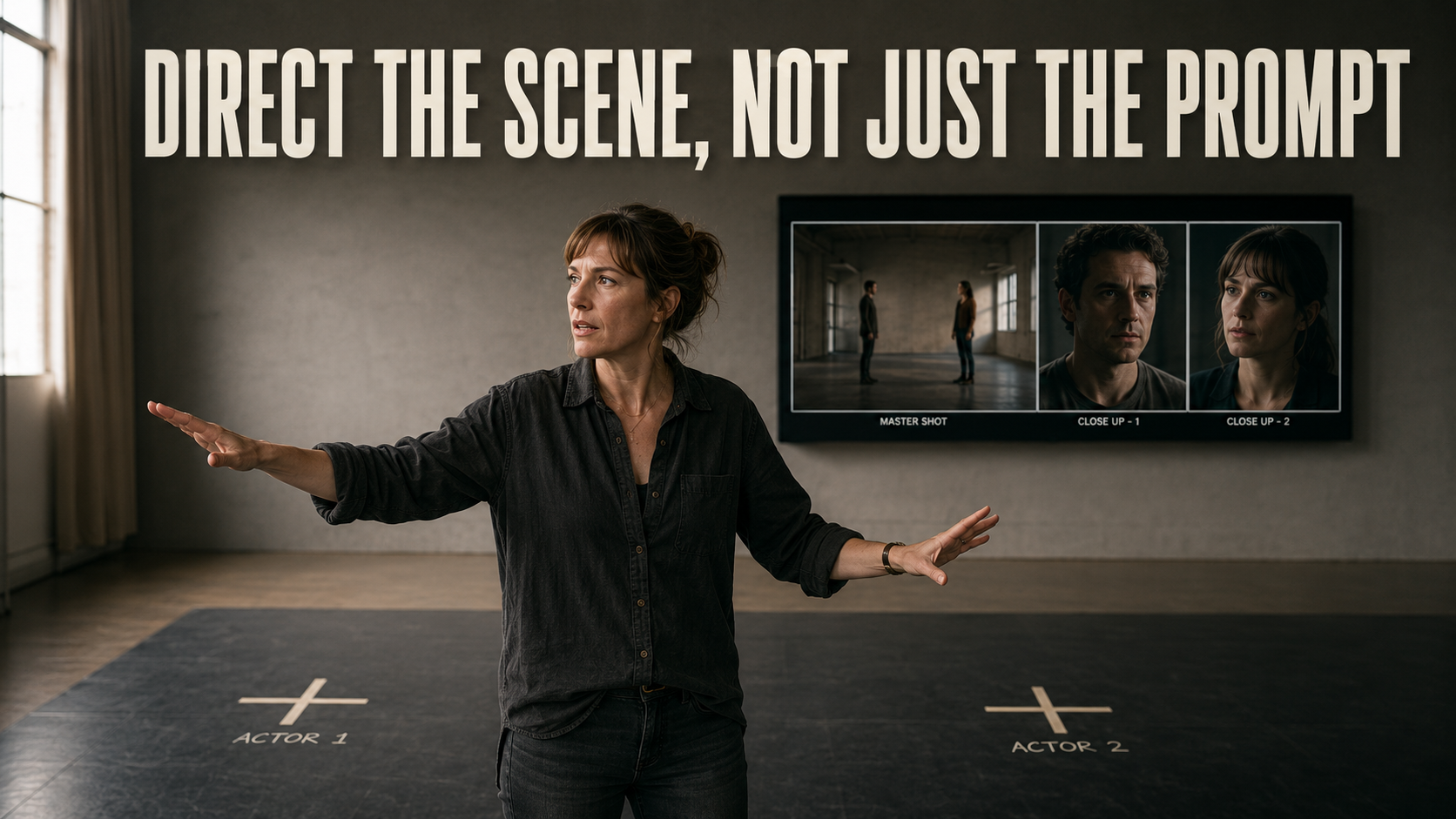
Coverage and blocking describe how a scene is physically staged and shot from multiple angles so an editor has enough material to cut a beat together. In traditional production this is a cinematographer's job on set, worked out in rehearsal with actors physically present in a room. In AI microdrama production it has to be decided during scene development, because there is no set and no camera operator improvising a second angle if the first one does not cut well. Directing AI characters like a DP means deciding blocking and coverage on paper before a single frame generates, and treating that decision with the same seriousness a live-action production would.
What blocking means when there is no physical set
Blocking is where characters stand, move, and face relative to each other and the camera. In AI production, blocking is written as part of the location layer: where Mira stands relative to the door, whether Daniel is seated or pacing, which direction each character faces so eyelines match across shots. Eyeline consistency matters more in AI generation than in live production, because a slight mismatch between two independently generated shots reads as a jump cut error rather than a stylistic choice, and there is no camera operator on set to catch it before it happens. Writing blocking down before generation is what keeps a two-shot conversation feeling like it is happening in one continuous space rather than two characters recorded separately and pasted together.
Blocking also needs to account for movement within a scene, not just a static starting position. If Daniel is meant to rise from the sofa partway through the confrontation, that movement needs to be written into the blocking so any shot generated after that point reflects his new position, not his original one. Skipping this detail is a common source of continuity breaks in longer scenes with more than one blocking state.
What coverage means for a microdrama scene
Coverage is the set of angles generated for a single scene so an editor has options when cutting. A well-covered scene includes a master shot showing both characters, individual mediums or close-ups on each character for reaction and dialogue, and at least one insert if a prop matters to the beat. The mistake most AI-native productions make is generating only the shots the writer imagined for the final cut, which leaves no flexibility if a scene needs to be re-timed or if a reaction reads better than expected and deserves more screen time than originally planned.
A useful minimum standard is to generate at least one more angle than the edit is expected to use. If the planned cut only needs three shots, generating a fourth as backup coverage costs one additional generation call and provides real insurance against a shot that renders with an unusable artifact, an expression that reads wrong, or a pacing problem discovered only once the scene is assembled.
The over-the-shoulder problem in AI generation
Over-the-shoulder shots, a staple of traditional dialogue coverage, are harder to generate reliably in AI video because they require two characters to hold consistent spatial relationship and scale across a shot that partially obscures one of them. Most AI microdrama productions in 2026 substitute alternating close-ups with matched eyelines instead of true over-the-shoulder framing, which achieves the same conversational rhythm without depending on a shot type that AI models still generate inconsistently. This is a workaround worth knowing before a shot list assumes coverage that the current generation stack cannot deliver cleanly, since discovering the limitation mid-production wastes generation budget on shots that need to be reworked anyway.
The matched eyeline substitute works because what an audience actually reads from an over-the-shoulder shot is proximity and directional attention, not the specific foreground shoulder in frame. Two alternating close-ups with eyelines that correctly cross, each character looking slightly off camera toward where the other is blocked to stand, delivers the same sense of two people talking to each other without requiring the harder shot type.
Building a coverage plan into the scene node
On MinionArts Vertex, coverage is planned as a set of shot nodes attached to a single scene, each one referencing the same locked blocking so every angle generated for the scene shares the same spatial logic. This means the master shot and the alternating close-ups are not independently prompted guesses at where the characters are standing, they all inherit the same blocking field from the scene layer, which is what keeps a conversation visually coherent when it is cut together from shots generated minutes or hours apart.
Coverage for scenes with more than two characters
Scenes with three or more characters need a different coverage strategy than two-person dialogue, since alternating close-ups stop working cleanly once there are more directions of attention in the room to track. A common approach is a wider group shot to establish everyone's position, followed by close-ups on whichever character is speaking or reacting most significantly at any given moment, with the blocking layer explicitly noting where each character stands relative to the others so a close-up on any one of them still makes spatial sense when cut against the group shot.
A worked example: blocking and coverage for one confrontation
For the penthouse confrontation used earlier, a full blocking and coverage plan looks like this. Blocking: Mira stands near the window facing into the room, Daniel is seated on the sofa facing toward the window, roughly six feet apart, both facing each other directly so their eyelines cross correctly in any alternating close-up. Coverage: a master two-shot from a neutral angle showing both positions, a medium close-up on Mira looking screen right toward Daniel, a matching medium close-up on Daniel looking screen left toward Mira, and one insert on Daniel's hands gripping the edge of the sofa as the confrontation escalates. Four angles, one locked blocking reference, and eyelines that cross correctly in every close-up because both characters' facing direction was decided once rather than guessed at per shot.
Common coverage and blocking mistakes
The most frequent mistake is writing coverage before blocking, which means the shot list gets built first and the spatial logic gets reverse engineered from whatever the shots happen to show, often producing eyeline mismatches that only become visible once shots are cut together. The correction is always to lock blocking first, even in a single sentence, before deciding which angles to generate. A second common mistake is treating every scene identically regardless of character count, applying a two-person alternating close-up pattern to a four-person scene where it no longer holds up, producing a sequence where the audience loses track of who is where in the room.
Reusing blocking across a recurring location
Locations that recur across a season, a family dining room, an office where recurring meetings happen, benefit from a standard blocking template rather than fresh blocking decided from scratch every time the location appears. If Mira always enters from the same door and the head of the table is always occupied by the same character, locking that pattern once means every future scene in that location inherits a spatial logic the audience has already implicitly learned, which makes each new scene there feel immediately familiar rather than requiring the audience to reorient. This reuse also reduces planning time significantly on later episodes, since a returning location's blocking template can be pulled from the reference library rather than rebuilt, leaving fresh blocking decisions for genuinely new locations and new spatial arrangements only.
Frequently Asked Questions
What is blocking in AI video production? Blocking is where characters stand, move, and face relative to each other and the camera, written into the scene's location layer so every shot in the scene shares consistent spatial logic and matching eyelines.
What does coverage mean for a microdrama scene? Coverage is the full set of angles generated for one scene, typically a master shot plus individual close-ups per character, giving an editor options rather than only the exact shots a writer originally imagined.
Why are over-the-shoulder shots hard to generate with AI? They require two characters to hold consistent spatial relationship and scale in a single shot, which current AI video models generate inconsistently, so many productions substitute alternating matched close-ups instead.
How much coverage does a typical microdrama scene need? Enough to survive a re-edit: a master or wide, one medium or close-up per character present, and an insert if a prop matters to the beat, plus one backup angle where budget allows.
How does blocking change for scenes with more than two characters? A wider group shot establishes everyone's position first, and close-ups follow whichever character is speaking or reacting, with the blocking layer noting each character's position so any close-up still makes spatial sense against the group shot.
What happens if a character's position changes mid-scene? The blocking needs to be updated to reflect the new position, or any shot generated after the movement will contradict the character's established location and break spatial continuity.
Coverage and blocking are what keep an AI-generated conversation feeling like it is happening in one room instead of several disconnected renders stitched together. Planning both as part of the scene, before generation, is the difference between directing AI characters and simply prompting them.