Introduction
AI UGC ad creation is the use of generative AI models to produce user generated content style video ads that look, sound, and feel like authentic creator content but are produced through an automated or semi automated pipeline. The output matches the aesthetic of traditional UGC, a creator speaking to camera or demonstrating a product in a natural setting, but the production replaces the need for human casting, shooting, and post production with a set of AI models that handle image generation, video generation, voice synthesis, and assembly.
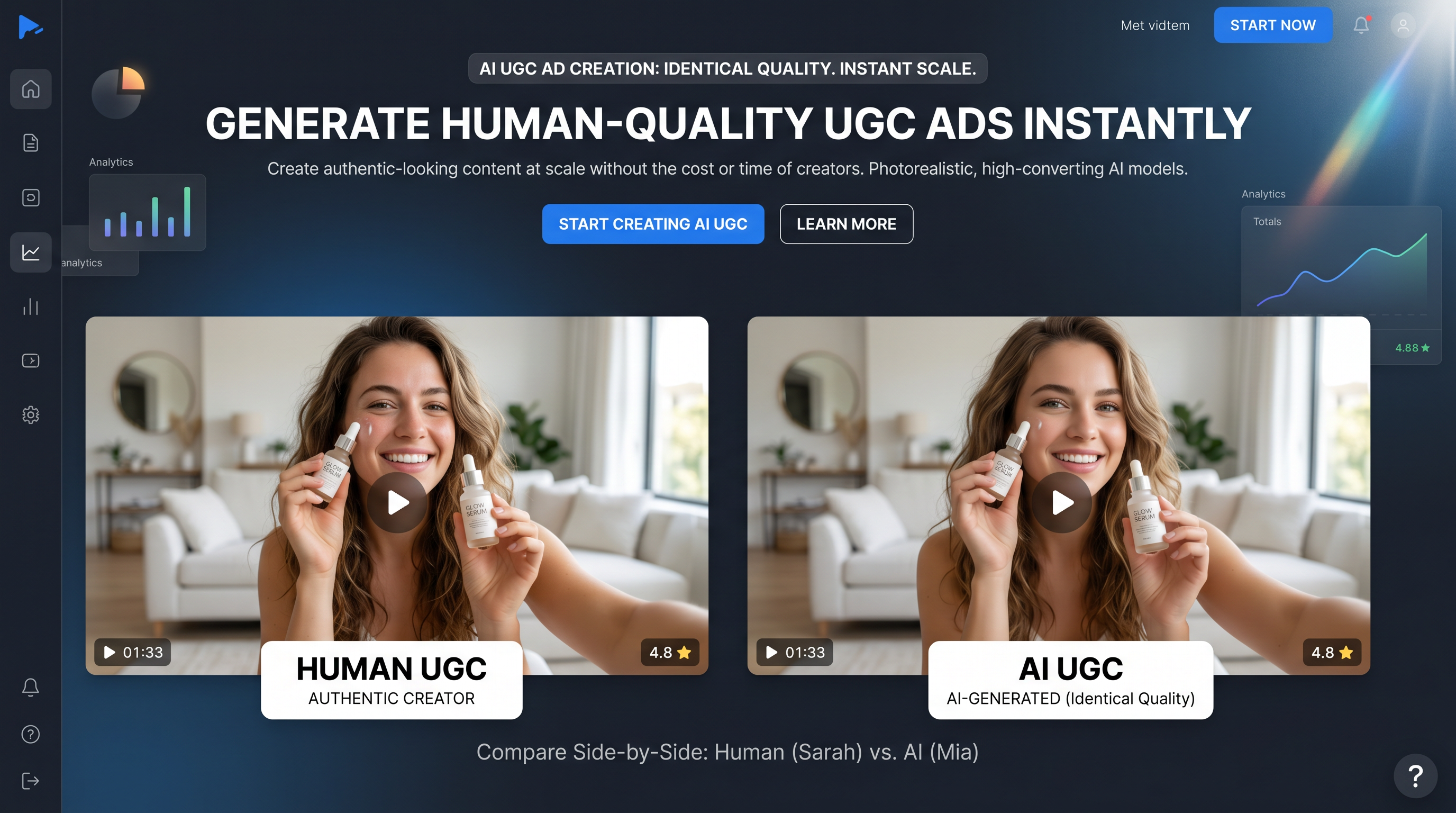
By the start of 2026, AI UGC has moved from novelty to standard practice across D2C brands, boutique agencies, and in house creative teams. The shift happened quickly because the economics changed fast. A creator brief that required five days and two thousand dollars in 2023 now completes in two hours at a fraction of the cost, and the quality gap that used to mark AI work as obviously synthetic has closed to the point where AI and human UGC test within five percent of each other on CTR and CPA in blind placement tests.
This guide covers the full production pipeline. It explains how AI UGC ads are structured, which model stack to use, how platforms like Meta and TikTok respond to the format, and how to move from a single ad to a programmatic production engine that produces fifty variations per week. The target reader is a performance marketer or creative lead who wants to either add AI UGC to an existing program or replace parts of their current creator workflow with AI infrastructure that enhances the team's output.
Why brands are moving to AI UGC in 2026
The shift to AI UGC is driven by four forces. The first is cost. A typical human UGC video from a mid tier creator costs 150 to 400 dollars per asset depending on market and specification. The equivalent AI UGC produced in Vertex costs under five dollars in compute, with the production time collapsing from seven days to under an hour. At volume this difference compounds. A brand running fifty creative tests per month pays roughly 15,000 dollars for human UGC where AI UGC lands near 250 dollars in compute with team time factored separately.
The second force is variation speed. Paid social performance is driven by volume of tested creative more than any other single variable. Traditional UGC can produce three to five variants per brief. AI UGC produces fifty in the same time window because variation is handled by prompt permutation rather than reshooting. This changes the economics of creative testing and allows winning concepts to surface faster.
The third force is localization. AI UGC produces a Hindi version, a Spanish version, and a Portuguese version from the same source assets without recasting. Global brands that used to run one hero campaign in English and hope it translated now ship five native language versions at launch. The fourth force is iteration. A feature change, a new claim, or a seasonal refresh no longer requires a new shoot. It requires a prompt edit and a regenerate.
The AI UGC production pipeline
The production pipeline has six stages and each stage maps to specific AI models or Vertex nodes. Understanding the pipeline as a sequence of stages is more useful than thinking about it as a single tool because each stage has its own decisions and quality gates.
Stage one is the brief. This is written as it would be for a human creator. It specifies the product, the core message, the target audience, the platform, and the required length. The difference is that the brief must also specify creator archetype, setting, and wardrobe because these are inputs the AI pipeline needs explicitly rather than implicitly.
Stage two is script writing. The script follows a hook promise close structure. The hook lands in the first second. The promise establishes what the viewer gains by continuing. The close drives to the platform appropriate action. Scripts are written specifically for AI voice delivery which means shorter sentences, clearer phrasing, and explicit emotional cues.
Stage three is creator and setting generation. The creator archetype is rendered as a reference image using Flux or Imagen with a highly detailed prompt covering age range, ethnicity, styling, and expression. The setting is rendered separately or implied in the creator generation depending on the shot structure. These reference images become the anchors for video generation.
Stage four is video generation. Veo 3.1 Fast, Kling 2.0, or Runway Gen 4 takes the reference image and animates it with motion matched to the script beats. This is where the heavy compute and the biggest quality decisions happen. Stage five is voice generation using ElevenLabs, MiniMax, or PlayHT with script tuned for delivery. Stage six is assembly where video, voice, captions, and any platform specific elements come together in a merge node.
The model stack in 2026
The standard model stack for AI UGC production in 2026 leans on a small number of reliable combinations. For video, the most common choices are Veo 3.1 Fast for its strong dialog output and character coherence, Kling 2.0 for superior motion and physical action, and Runway Gen 4 for its strong lipsync and creative director friendliness. For image reference, Flux and Imagen both hold strong positions with Flux favored for character realism and Imagen favored for product accuracy.
For voice, ElevenLabs remains the default for most English language production with MiniMax rising quickly for multilingual needs, particularly Hindi, Mandarin, and Spanish. PlayHT covers use cases where voice cloning is needed. A full production pipeline will typically use three to four of these in combination, orchestrated through a Vertex workflow that passes outputs between them.
Platform specific production for Meta and TikTok
Meta and TikTok respond differently to AI UGC and the production needs to account for that. Meta ads tend to reward polish and clear messaging. AI UGC for Meta works well when it looks like a well produced creator clip, with clean lighting and controlled delivery. TikTok rewards native texture and cultural fluency. AI UGC for TikTok needs slight imperfection, handheld feeling camera work, and on trend styling cues.
Both platforms also have compliance frameworks that affect AI UGC specifically. Meta requires disclosure of AI generated content in certain contexts, particularly political or newsworthy content. TikTok enforces its AI disclosure rules aggressively for anything that could be mistaken for a real person making real claims. The production pipeline needs to account for these requirements at the assembly stage, not after the fact.
Scaling from one ad to fifty per week
The jump from producing a single AI UGC ad to running a production system that ships fifty per week is an architectural shift, not a volume shift. A single ad pipeline is a linear sequence of tool calls. A production system is a workflow template with clearly defined variation axes, a concept matrix that generates ad ideas systematically, a batch processing capability, and a QA gate that catches the ten percent of outputs that need regeneration.
In Vertex this is typically structured as a master workflow with an interface form that takes product, hook type, creator archetype, and platform as inputs, then runs the full pipeline. A brand marketer can request a new ad variation by filling in the form and waiting thirty minutes for the finished output. The creative director does not personally build each ad. They define the system and review the output.
Getting started with AI UGC
The most direct path to getting started is to pick one existing campaign and produce AI UGC variations that run alongside the human creator variations for two weeks. Match the creator archetype as closely as possible and run the same budget allocation to both sets. At the end of two weeks, look at CTR, CPA, and hold rate for each set. In most cases the AI UGC variations will sit within five percent of the human baseline. If the AI UGC variations outperform, expand the production volume. If they underperform, the learnings usually concentrate in script delivery or creator realism and can be iterated without a full pipeline rebuild.
MinionArts Vertex is built for this exact production pattern. A first working AI UGC ad can be built in a single afternoon following the workflow template library, and the same template scales to fifty variations per week when the production program matures.
FAQ
Do AI UGC ads need disclosure on Meta and TikTok?
Disclosure requirements depend on the content. Product demonstration ads that make no factual claim about real events generally do not need disclosure. Ads that feature an AI person making claims that appear to be testimonial require care and may need disclosure depending on the claim type and jurisdiction. Check current Meta and TikTok policy before launching.//
Can AI UGC replace a full creator program?
It can replace the production layer. It does not replace the strategic layer of creator selection, audience insight, and message craft. Teams that treat AI UGC as a production infrastructure that enhances the creative team tend to outperform teams that treat it as a full creator program replacement.
What does AI UGC production actually cost at scale?
Compute cost for a single high quality AI UGC ad in Vertex is typically between one and five dollars depending on length and complexity. A brand producing fifty ads per week spends 250 to 1,250 dollars in compute per week plus the cost of the team reviewing and deploying the outputs. Full human UGC at the same volume typically costs 7,500 to 20,000 dollars per week at agency rates.