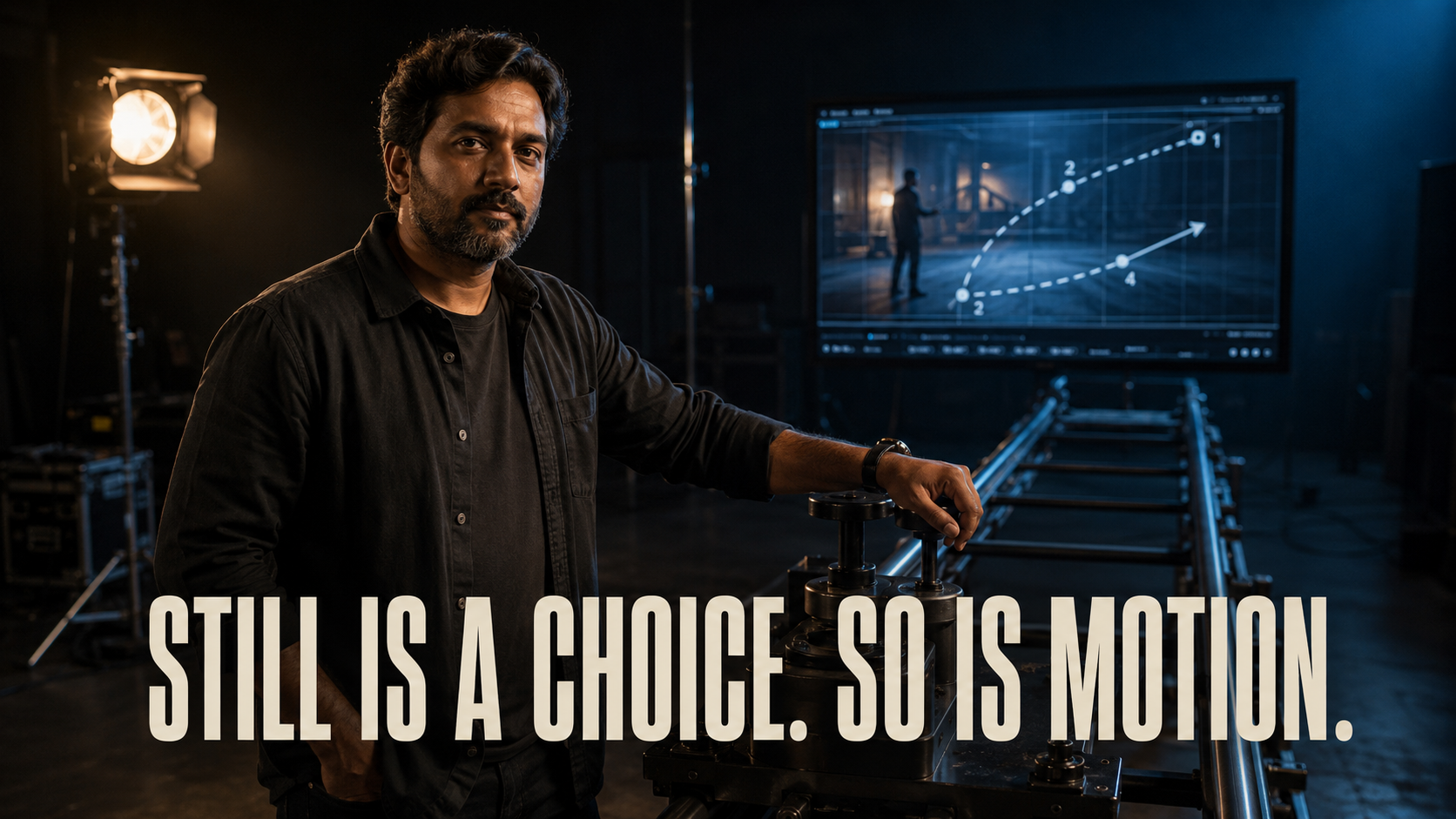
Camera movement grammar for AI-generated video is the set of motion instructions, push, pull, pan, tilt, handheld drift, that translate a scene's emotional intent into a prompt the generation model can execute consistently. Static AI shots read as stills with motion applied. Deliberate camera movement, chosen the same way a cinematographer would choose it, is what makes an AI-generated scene read as directed rather than generated, and it is one of the most reliable ways to raise the perceived production value of a season without changing the underlying model.
The core movement vocabulary
A push in, moving the camera slowly toward the subject, is the most reliable movement for building intensity into a close-up and pairs naturally with a scene's emotional peak. A pull back does the opposite, revealing context or isolating a character within a space, and works well at the end of a scene to signal a shift in stakes. A pan, moving horizontally, follows action or reveals a second character entering a beat. A tilt reveals scale, moving up a tall building or down to a dropped object. Handheld drift, a subtle unsteady motion, signals urgency or emotional instability and should be used sparingly since overuse reads as low production value rather than intentional style.
A sixth movement worth naming separately is the arc, where the camera moves in a curved path around a subject rather than straight toward or away from it. Arcs are more demanding to generate cleanly and are best reserved for a season's highest-stakes moments, a betrayal reveal, a final confrontation, where the added visual weight is earned by the scene's importance rather than spent on an ordinary beat.
Why movement needs to be specified, not assumed
Generation models default to a locked or minimally drifting camera unless movement is explicitly prompted, which means a scene with no camera instruction in the prompt will generate technically correct but visually inert shots. The fix is treating camera movement as a required field in the camera layer of scene development, the same way shot type is required, rather than an optional flourish added if there is time. A push in written into the prompt as a specific instruction, moving from medium to close over the duration of the shot, produces a materially different result than a prompt that only specifies close-up and hopes the model adds motion.
Precision in the instruction matters as much as including one at all. A vague instruction like camera moves closer produces inconsistent results across a batch of shots, while a specific instruction naming the start framing, the end framing, and the pace of the move, slow, over the full duration of the shot, produces results that are far more repeatable across a full episode's worth of generations.
Matching movement to emotional intent
Movement choice should follow the same rule as shot selection: it serves the scene's emotional target rather than being chosen for variety. A slow push in during a confession beat builds intimacy and pressure. A pull back at a betrayal reveal creates distance and lets the audience process the moment from outside the character's immediate experience. A handheld drift during a confrontation adds instability that mirrors the emotional state of the scene. Movement chosen without reference to the emotional layer tends to feel decorative, technically smooth but narratively disconnected from what the beat is trying to do.
A practical test during scene development is to ask whether the chosen movement would make sense to a viewer with the sound off. A push in on a confession reads as tension even in silence. An unmotivated pan across a static conversation reads as noise regardless of what the dialogue is doing. If the movement does not communicate something on its own, it is decoration rather than direction.
Movement consistency across a scene's shot list
A scene's shot list should vary movement deliberately rather than repeating the same push or pan across every shot in a sequence, which reads as a technical limitation rather than a style choice. A typical scene alternates a static or slow-push medium shot for dialogue with one clearly moved shot, a push, pull, or pan, placed at the beat's turning point. On MinionArts Vertex, movement type is set as a field on each shot node within the scene cluster, so the variation is planned during scene development and carried consistently into every generation call rather than left to chance per shot.
Movement pacing across an episode
Movement choice should also be planned at the episode level, not just the scene level. An episode that opens with slow, deliberate pushes and gradually introduces faster pans and handheld drift as it approaches its ending hook mirrors the acceleration of the story itself. An episode that uses the same movement style throughout, regardless of where it sits in the runtime, misses a free opportunity to reinforce pacing visually. Mapping movement intensity against the episode's escalation curve, alongside shot duration and cut rhythm, is part of what makes a well-produced episode feel like it is building toward something rather than simply running out the clock.
A worked example: writing a movement instruction
A weak camera movement prompt might read simply as close-up, camera pushes in. A strong version, written for the same shot, reads as: medium close-up on Mira's face, camera pushes in slowly over the full four second duration, ending on a tight close-up as she delivers her final line, no handheld movement, locked horizontal axis. The second version specifies start framing, end framing, pace, and axis stability, four variables that a vague instruction leaves to chance. Across a batch of shots using the same movement type, this level of specificity is what keeps the push in reading as the same deliberate choice in shot twelve as it did in shot one, rather than drifting into a slightly different speed or framing each time it is regenerated.
Common camera movement mistakes
The most common mistake is applying the same movement to every shot in a season regardless of context, usually because one movement type generated reliably early in production and the team defaulted to reusing it. This produces a season that feels visually monotonous even when the underlying story is varied. A second common mistake is over-using handheld drift specifically, treating it as a default marker of intensity rather than reserving it for genuine moments of instability, which dilutes its effect and can read as an unintentional generation artifact rather than a style choice. The fix for both is the same discipline applied to shot selection: movement should be chosen scene by scene against the emotional layer, not defaulted to whatever worked last time.
Combining movement with shot type deliberately
Movement and shot type are frequently planned as if they were independent decisions, when in practice certain combinations carry more weight than others. A push in on a wide shot reveals information gradually and works well at the start of a scene. A push in on a shot that is already a close-up has almost nowhere left to go and tends to look strained rather than intense, since there is little remaining frame to close in on. A pull back from a close-up to a medium is one of the more effective ways to signal an emotional retreat, a character physically or figuratively pulling away from a moment, and pairs well with a line of dialogue that undercuts or walks back something just said. Planning shot type and movement together, rather than choosing a shot type and then bolting a movement onto it afterward, produces combinations that reinforce each other instead of fighting for the same visual space.
Frequently Asked Questions
Do AI video models generate camera movement automatically? Not reliably. Most models default to a static or minimally drifting camera unless a specific movement instruction is included in the prompt, so movement should be treated as a required field rather than assumed.
What camera movement works best for emotional close-ups? A slow push in from medium to close is the most reliable movement for building intensity into a close-up moment.
Is handheld camera movement good for microdrama? Used sparingly at moments of instability or urgency, yes. Overused across most shots, it reads as low production value rather than an intentional style choice.
How is camera movement planned in a node-based production pipeline? Movement type is set as a field on each shot node during scene development, so it carries through to generation automatically instead of being decided shot by shot.
What makes a camera movement instruction more reliable across a batch of shots? Naming the start framing, end framing, and pace of the move explicitly produces more consistent results than a vague instruction like the camera moves closer.
Should movement intensity change across an episode's runtime? Yes. Slower, more deliberate movement early in an episode building toward faster pans and handheld drift near the ending hook reinforces the story's own escalation.
Camera movement is what separates a directed AI scene from a generated one. Treating movement as a required, emotionally motivated field in scene development, rather than an afterthought, is what gives a microdrama season the visual language of something a person actually directed.