Camera angles and shot types for vertical AI microdrama follow the same grammar as traditional film, wide, medium, close-up, and insert, but reframed for a 9:16 canvas where the safe zone for faces and text sits in the center third of the frame. Getting shot selection right is what separates a microdrama that reads as cinematic from one that reads as a slideshow of AI images with motion added. In 2026, the studios producing the highest completion rates treat shot selection as a deliberate craft decision per beat, not a default the model happens to generate.
The core shot types and what each one is for
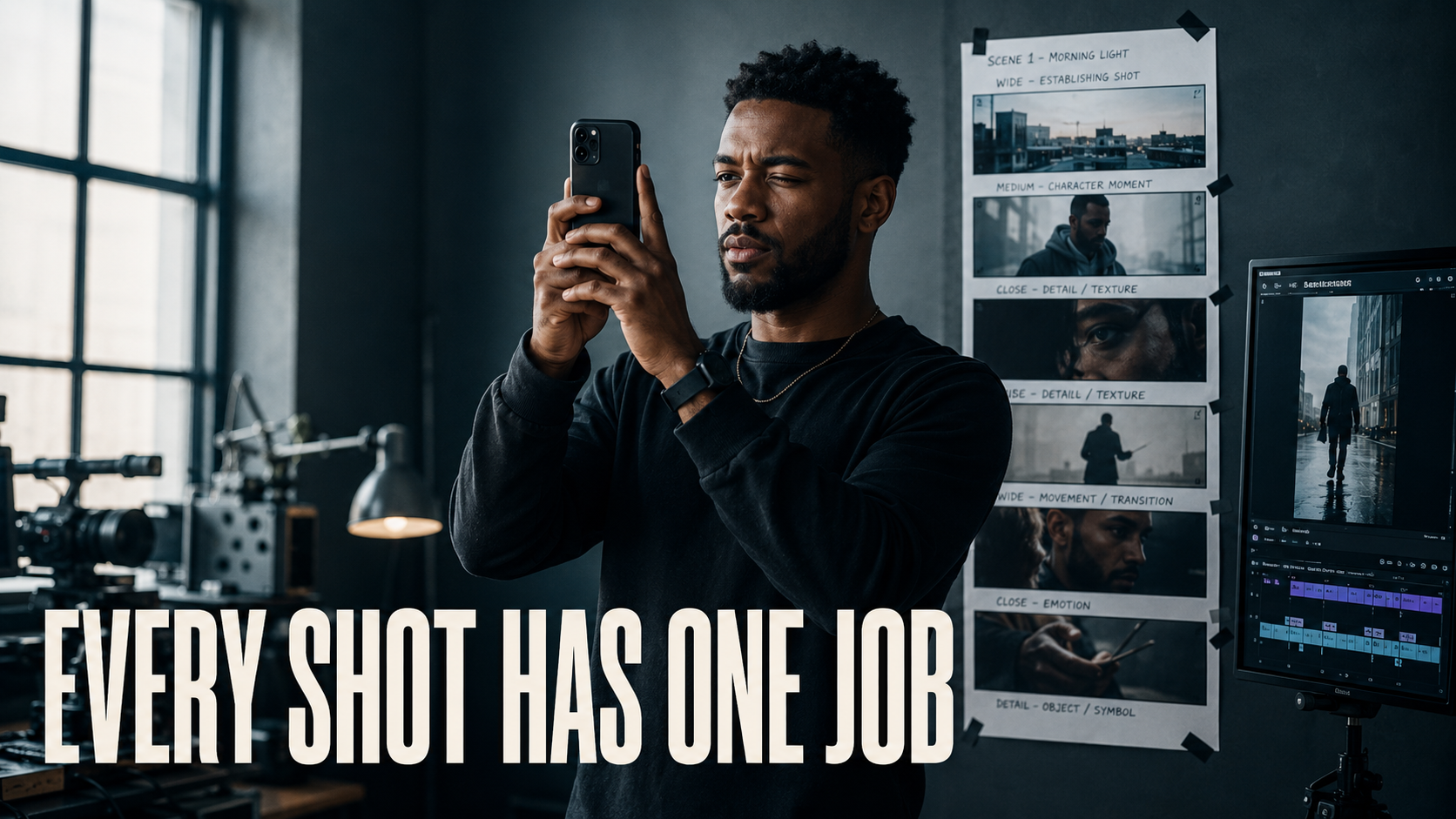
A wide shot establishes geography, who is in the room and where, and is used sparingly in vertical drama because 9:16 compresses width and wastes detail on a small phone screen. A medium shot, framed roughly waist up, is the default coverage for dialogue because it keeps both expression and body language visible without crowding a vertical frame. A close-up isolates the face and carries the emotional weight of a scene, used at the moment a line needs to land rather than throughout the whole beat. An insert shot, a ring, a phone screen, a hand closing around a glass, delivers information without a face and is one of the cheapest ways to add visual variety to a scene without generating a new full character shot.
Beyond these four, two secondary shot types are worth planning for. An over-the-shoulder style angle, framed from behind one character toward the other, implies proximity and confrontation even in scenes that never fully commit to true OTS framing, which current AI models still generate inconsistently. And a point of view shot, framed as if seen through a character's eyes, is rare in microdrama but highly effective at a single key moment, a threat, a reveal, a decision, precisely because its scarcity makes it land harder when it is used.
Shot selection follows the emotional layer, not the other way around
The scene's emotional target, set during scene development, should decide the shot before the camera prompt is written. A humiliation beat wants a slow push into a close-up as the character absorbs the moment. A reveal beat wants to hold wide just long enough for the audience to read the room before cutting in. A confrontation wants coverage that alternates tight on both characters so the exchange feels like it has stakes. Studios that write camera choice before emotional intent end up with technically correct but emotionally flat scenes, because the shot type was chosen for coverage, not for meaning.
This ordering, emotion first, camera second, is the single highest-leverage discipline in vertical drama cinematography. It costs nothing to enforce and it is the difference between a season that feels directed and one that feels assembled from a template, regardless of how good any individual generated frame looks.
9:16 framing rules that differ from horizontal film
Vertical framing changes three things that horizontal shot grammar does not account for. First, headroom is tighter, so a close-up in 9:16 sits higher in frame than the same shot composed for 16:9, and leaving traditional horizontal headroom in a vertical close-up wastes screen real estate that should be holding the face. Second, two-shots are harder to read, since two people side by side in a vertical frame either crowd the center or push one character toward the edge where mobile UI elements like captions and progress bars sit. Third, the safe zone for any on-screen text or paywall prompt occupies the lower third, so shots with dialogue subtitles need headroom planned above that zone rather than centered on the whole frame.
A fourth, less obvious rule: depth cues matter more in vertical framing than horizontal, because there is less width available to separate a subject from its background visually. Shallow depth of field, a blurred background against a sharp subject, does more work in 9:16 than in 16:9 to keep a shot from reading as flat, and should be treated as a default rather than an occasional stylistic choice.
Building a shot list per scene
A well-built scene in a Vertex season canvas typically runs three to five shots: an opening wide or medium to establish, one or two mediums to carry dialogue, and a close-up placed at the scene's emotional peak. Insert shots are added where a prop or detail needs to register without spending a full character generation. This shot list is written once as part of scene development and reused as the generation plan, so every shot in the sequence has a defined purpose rather than being generated ad hoc and assembled after the fact.
A useful discipline when building this list is to ask, for every shot, what would be lost if it were cut entirely. If the answer is nothing, the shot is decorative and can be dropped, saving a generation call and tightening the scene. If the answer is a specific piece of information or emotional beat, the shot earns its place in the sequence.
Matching shot rhythm to scene length
Shot count should scale with scene length, not the other way around. A short scene budgeted for eight to ten seconds cannot support five shots without each one reading as a flash cut, while a longer scene of twenty to twenty-five seconds can sustain more coverage without feeling rushed. Planning shot count against the time budget during scene development, rather than generating a fixed number of shots per scene regardless of length, keeps the pacing of each individual scene coherent before it ever reaches the edit.
A worked example: shot selection for one scene
Take a fourteen second scene where a character opens a letter that changes the season's plot. A shot list built around emotional intent might run: shot one, a medium shot of the character at a table, three seconds, establishing calm before the disruption. Shot two, an insert of the envelope being opened, two seconds, building anticipation without a face in frame. Shot three, a close-up of the character's eyes scanning the letter, four seconds, the emotional center of the scene. Shot four, a wider shot pulling back as the character sets the letter down, five seconds, giving the audience room to process before the scene cuts away. Four shots, fourteen seconds, each one earning its place because removing any single shot would either lose information or flatten the emotional arc of the beat.
Common shot selection mistakes
The most frequent shot selection error in AI microdrama production is over-covering a scene with close-ups because close-ups are the most reliable shot type to generate cleanly, not because the beat calls for them. A scene shot entirely in close-up loses spatial context and starts to feel claustrophobic rather than intense. The opposite error, staying wide throughout a scene to avoid generation inconsistency in close-up expressions, drains emotional weight from moments that need it. Both errors trace back to the same root cause: letting generation reliability drive shot choice instead of letting the scene's emotional target drive it, with generation constraints handled separately as a technical problem to solve rather than a reason to avoid a shot type altogether.
Shot variety across an episode, not just within one scene
Shot planning also needs to be checked at the episode level, not only scene by scene. A season where every scene independently follows the same wide-to-medium-to-close pattern can still end up feeling repetitive across an episode, even though each individual scene was planned correctly. Reviewing a full episode's shot list side by side, rather than only reviewing scenes in isolation, catches this kind of pattern repetition before it becomes a season-wide habit. Some studios solve this by deliberately varying which shot type opens each scene within an episode, an insert opening one scene, a medium opening the next, a wide opening a third, so the episode's visual rhythm has variation built in even when individual scenes are structurally similar. This is a cheap review step, typically a few minutes scanning a printed or exported shot list, and it catches a class of pacing problem that is otherwise invisible until the finished episode feels monotonous for reasons that are hard to pin down in the edit.
Frequently Asked Questions
What is the most common camera angle in vertical microdrama? The medium shot, because it holds both expression and body language in the safe zone of a 9:16 frame and works for the majority of dialogue-driven beats.
How many shots does a typical microdrama scene need? Three to five, moving from an establishing shot through dialogue coverage to a close-up at the scene's emotional peak, scaled against the scene's time budget.
Why do wide shots work differently in vertical video? A 9:16 frame compresses horizontal space, so a wide shot that would read clearly in 16:9 loses detail and geography on a phone screen, which is why vertical drama uses wide shots sparingly.
Should camera choice be decided before or after the script is written? After the script and after the scene's emotional target is set. Camera choice should serve the beat's intent rather than dictate it.
Why is shallow depth of field more important in vertical framing? With less horizontal space to separate a subject from its background, a blurred background does more work in 9:16 than in 16:9 to keep a frame from reading as visually flat.
When is a point of view shot worth using in microdrama? Sparingly, reserved for a single high-stakes moment such as a threat or a reveal, since its rarity is what makes it land when it appears.
Shot selection is a craft decision, not a default. Vertical microdrama that reads as intentional, rather than assembled, is built scene by scene from a shot list that serves the emotional target of the beat. MinionArts Vertex carries the shot plan from scene development directly into generation nodes so each shot in a sequence is purposeful rather than arbitrary.