TikTok Shop has emerged as the fastest growing paid social channel for D2C commerce, and AI UGC has become the dominant production format for sellers running at volume. The platform rewards native looking content that sits inside cultural moments rather than polished advertising. AI UGC fits this profile when the production prioritizes authenticity cues over polish. Brands shipping one hundred AI UGC variants per week for TikTok Shop are common in categories like beauty, supplements, fashion, and home goods.
This playbook covers the production approach that makes TikTok Shop AI UGC work at scale. It explains the platform's creative requirements, the trend native hook patterns, the Vertex workflow structure for high volume output, and the measurement approach for a program this fast moving. The target reader is a TikTok Shop seller or performance team that needs to move from manual creator sourcing to an infrastructure that produces creative at platform speed.
What TikTok Shop rewards in creative
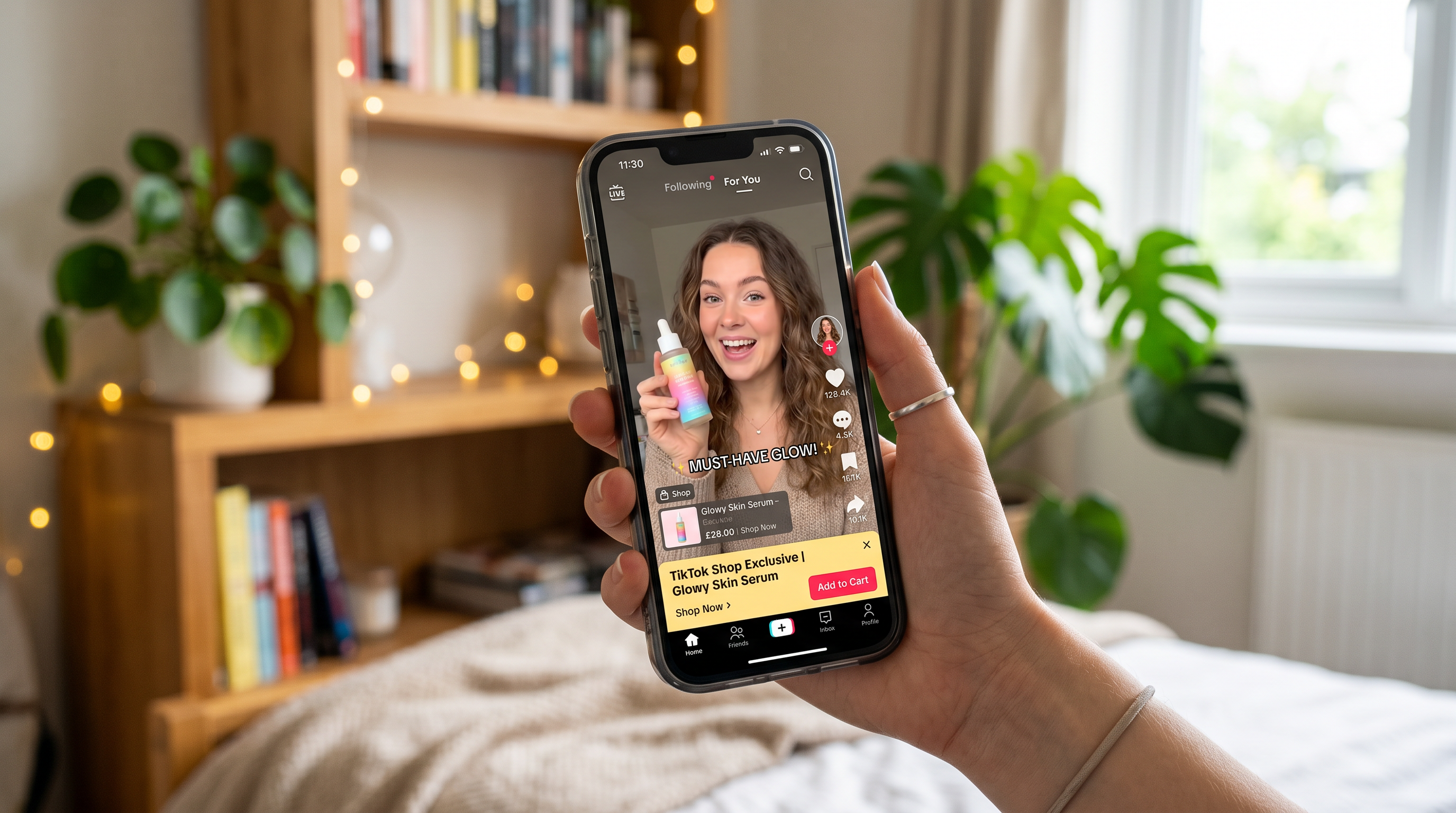
TikTok Shop ads sit in the For You Page alongside organic content. The algorithm rewards ads that look like organic content, pacing that matches organic content, and hooks that fit the cultural moment on TikTok right now. This is different from Meta where polished ads can perform well in feed. On TikTok Shop, the more an ad looks like a polished commercial, the worse it tends to perform.
The three creative standards that define a strong TikTok Shop ad are native visual texture, platform appropriate pacing, and trend aware framing. Native visual texture means handheld feeling camera work, natural lighting rather than studio lighting, and casual composition. Platform appropriate pacing means fast cuts, quick hook reveals, and text overlays that match the platform's visual vocabulary. Trend aware framing means the ad references or adapts a current TikTok trend without feeling like a cynical attempt at it.
Native styling for AI UGC on TikTok
Producing AI UGC that reads as native on TikTok requires a deliberate set of prompt choices. The video generation should specify handheld camera, natural window light, and slightly imperfect framing. The settings should be apartments, bedrooms, bathrooms, and casual outdoor locations rather than studios or commercial spaces. The creator's styling should match what actual TikTok creators wear, which skews toward casual and lived in rather than put together.
The voice should also match TikTok cadence. This means slightly faster pace, more informal phrasing, and natural sentence breaks rather than clean professional delivery. ElevenLabs voices tuned for conversational delivery outperform voices tuned for advertising or narration. MiniMax voices often handle the casual cadence better for certain accents and languages.
The caption and overlay style should match TikTok conventions. Large sans serif text, high contrast, often with emoji or simple visual elements. The text should cover only part of the frame and should match the cadence of the voice delivery. Captions that follow cleanly behind the voice outperform captions that lead the voice by three or four words.
Trend native hook patterns
TikTok hooks work differently than Meta hooks. On Meta a hook can be a direct claim or a question. On TikTok a hook often needs to feel like it is starting mid thought. Hooks that start with the word so or but or wait consistently outperform hooks that start with clean openers. The illusion of dropping into a conversation in progress is a core TikTok pattern.
Six trend aware hook patterns work for AI UGC on TikTok Shop. The first is the mid conversation drop where the creator appears to be continuing a thought. The second is the direct audience callout where the creator names the target demographic. The third is the in the moment reaction where the creator responds to something that just happened. The fourth is the routine check where the creator reveals part of their routine. The fifth is the hot take where the creator challenges a common assumption. The sixth is the product drop where the creator reveals a product in a way that implies it has changed something.
The hook needs to land in under one second. Anything longer and the scroll continues. AI voice delivery at natural pace can typically land a four to six word hook in one second. Hooks that exceed this need to be cut or paced faster in the voice generation. Testing hooks is the single highest leverage activity in a TikTok Shop program because hook win rate drives everything downstream.
The Vertex workflow for 100 variants per week
Producing one hundred AI UGC variants per week for TikTok Shop requires a Vertex workflow built around systematic variation rather than one off generation. The structure uses a CHAT node at the top to generate a batch of hook script variants from a seed brief, a JSON_EXTRACTOR to parse the batch into individual scripts, and parallel branches for video and voice generation that run simultaneously across the batch.
The creator archetype reference image is held constant across a batch so the variations share a consistent creator but vary in hook, script content, and setting. This keeps the brand signal stable while allowing enough variation to beat ad fatigue. A single batch typically produces ten to fifteen variants in under two hours of compute time. Ten batches per week produces the one hundred variant target.
The creative director or performance lead defines the seed brief and approves the batch output. They do not personally craft each variant. This is the fundamental architectural shift from traditional creative production. The system produces the volume and the human layer operates at the level of strategy, approval, and measurement.
Measurement at high variant volume
Running one hundred variants per week requires a measurement approach that can identify winners without human review of every variant. The standard pattern is to structure ad sets with a testing tier and a scale tier. The testing tier receives all new variants and runs each for forty eight hours at minimal spend. Variants that exceed the program's CTR and three second video view rate benchmarks graduate to the scale tier.
The scale tier runs the winning variants with higher budgets for five to ten days. The variants that continue to hit ROAS benchmarks stay. The ones that fade get cut. Winners from the scale tier become templates for the next round of variant generation, with the Vertex workflow adjusted to produce twenty to thirty close variants of each winner to extend its useful life.
Attribution on TikTok Shop is usually handled by TikTok's native pixel and catalog integration, supplemented by a third party attribution tool for brands running diversified spend. The specific tool matters less than having a consistent measurement stack that the team trusts for winner identification.
Compliance and platform review
TikTok Shop has specific compliance requirements that affect AI UGC directly. The platform enforces its synthetic media disclosure rules more aggressively than Meta and will reject or limit distribution for content that appears to be a real person making claims without disclosure. The production pattern that avoids rejection is to use clearly AI styled creators for product demonstration and reserve testimonial framing for content that includes the required disclosure.
Ad review rejections on TikTok often concentrate around claim language rather than production format. Beauty and wellness ads that make before after or transformation claims need careful compliance language even if the production is AI. The script layer is where most compliance issues originate, and building a claim library reviewed by legal once and reused across variants removes most ad review risk.
Scaling the program over time
A mature TikTok Shop AI UGC program builds a library of winning concepts over six to twelve months. Each winning concept becomes a template in Vertex that can be refreshed seasonally or when a new product launches. The template library compounds. By month twelve, a program that started producing ten variants per week is producing one hundred with roughly the same team size because the system does more of the work.
The creative team shifts from direct production to system design, template library curation, and concept ideation. This is not a reduction in creative work. It is a redirection of creative work toward higher leverage points. The teams that make this shift successfully tend to be the ones that captured the TikTok Shop opportunity early.
FAQ
Does TikTok detect AI UGC and suppress its distribution?
TikTok has AI content detection but does not suppress AI UGC as a category. It does enforce its synthetic media policies, which concentrate on undisclosed AI representation of real people and certain claim types. Product focused AI UGC that complies with platform rules distributes normally.
How much does producing one hundred TikTok Shop variants per week cost in compute?
Using Vertex with a standard model stack, one hundred fifteen second variants costs roughly six hundred to one thousand dollars per week in compute depending on model selection and length. Team time adds to this but the per variant production cost is a small fraction of human equivalent production.
Should I run the same AI UGC variants on TikTok Shop and Meta?
In most cases no. The native styling and pacing requirements differ enough that ads tuned for one platform underperform on the other. Producing platform specific variants from the same script foundation is a cleaner approach.