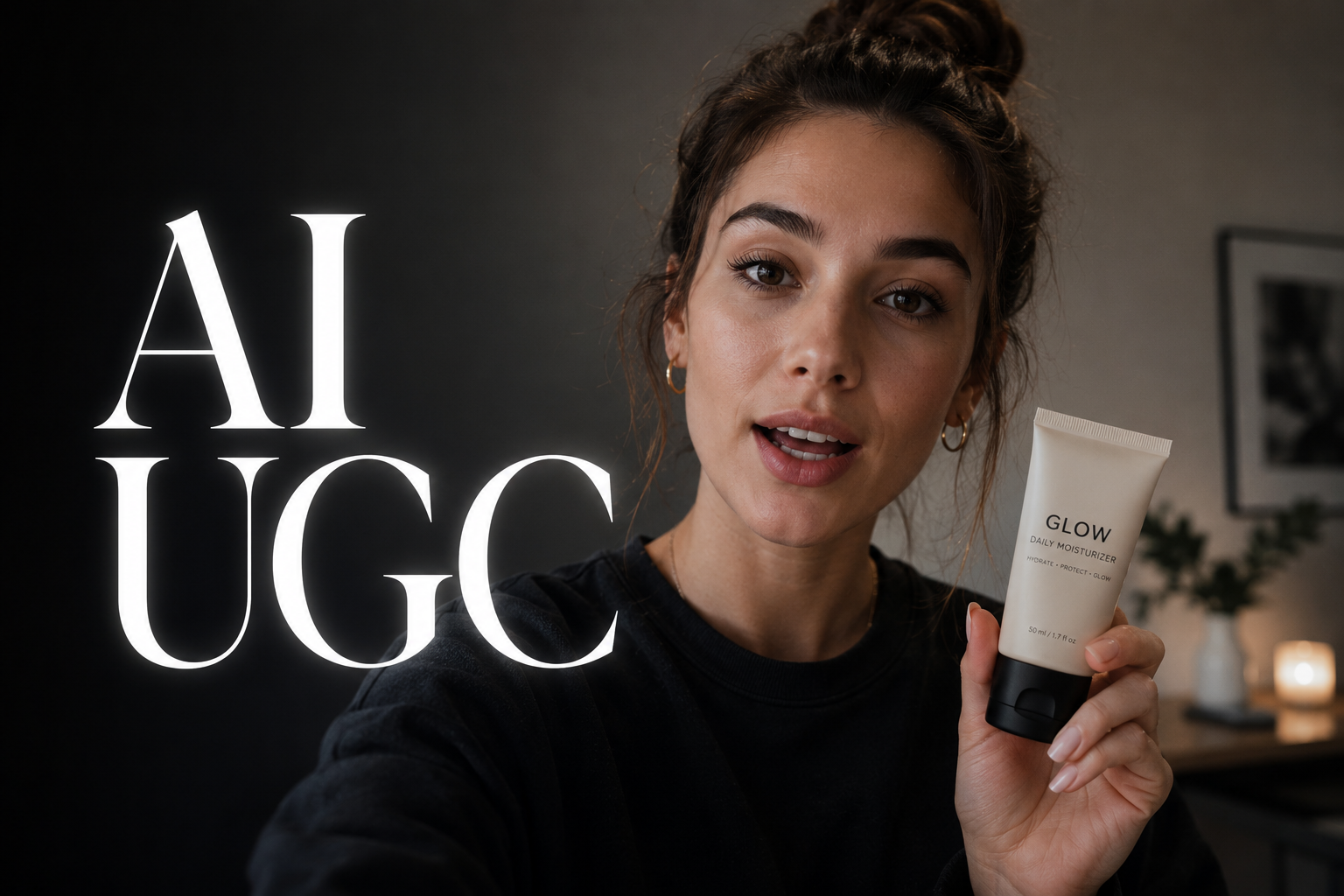
AI UGC ads are video advertisements that replicate the visual and verbal grammar of creator-produced content using generated characters, synthesized voice, and AI video models instead of real creators. In 2026, a single production pipeline can generate 50 to 100 UGC-style creative variants in a single session, at a fraction of the cost and time of managing a traditional creator roster.
What AI UGC Ads Are
UGC-style advertising has been one of the highest-performing creative formats in performance marketing for the past several years. The format works because it replicates the visual and verbal grammar of organic creator content: informal framing, direct-to-camera address, personal recommendation tone, visible environment rather than studio backdrop. Audiences trust it more than polished brand advertising because it reads as genuine rather than produced.
AI UGC ads replicate this format using generative models. When executed with attention to authentic visual codes, they perform at comparable levels to the creator-produced original while scaling to volumes and variant counts that a creator roster cannot produce.
The Four-Stage Production Architecture
A working AI UGC ad pipeline has four stages. The first stage is character generation: create a defined set of characters representing the target audience demographics for the campaign. Each character gets a consistent visual identity built from reference images that feed into the video generation stage.
The second stage is script development. UGC ad scripts follow a consistent structure: hook, problem statement, product introduction, demonstration or proof, and call to action. Write multiple variants of each section. The permutation of hook variants and proof variants produces the creative variant coverage that makes performance testing meaningful.
The third stage is video generation. Each script variant is matched with a character and run through a video generation model with appropriate scene parameters. For close-up talking head shots, character consistency is the primary requirement: Seedance 2.0 or Kling 3.0 with reference image anchoring. For product demonstration segments, motion plausibility matters more.
The fourth stage is audio overlay. Generated video is paired with synthesized voiceover matching the script. Voice models trained on specific accent and age profiles produce the vocal authenticity that makes AI UGC believable at scale.
What Makes AI UGC Believable in 2026
The difference between AI UGC ads that perform and those that do not comes down to visual authenticity signals. Real creator content has specific visual properties: slightly imperfect framing, environmental depth, natural lighting variation, ambient audio. AI-generated content defaults to over-composed, over-lit, and acoustically clean output that reads as produced.
Prompting for imperfection is counterintuitive but essential. Specify slightly off-center framing. Request visible environment depth rather than shallow focus. Describe ambient lighting rather than studio three-point setup. Include requests for natural hand movement and eye contact variation. These signals move AI UGC output from obviously generated to genuinely creator-like.
Scaling the System
Once the production architecture is established, scaling is a matter of running the pipeline at volume. A single configured pipeline produces 50 to 100 creative variants in a production session. Variants feed into a performance testing framework that identifies winning hooks, winning demonstrations, and winning character matches within the first week of campaign running. Winning elements scale. Underperformers retire. The feedback loop between production and performance data is what compounds campaign output quality over time.