A 24 hour microdrama production pipeline is a workflow where a complete vertical drama episode, or an entire multi episode drop, moves from locked script to published upload within a single working day. As of 2026, this is no longer an experiment. Chinese platforms are publishing more than 10,000 AI generated microdramas per month, and roughly 40 to 50 percent of the top 100 microdramas in China are already AI generated or heavily AI assisted. The studios winning this market are not the ones with the best single AI video generator. They are the ones running same day production infrastructure.
What Same Day Microdrama Production Actually Requires
Most teams assume a same day pipeline just means faster generation. It does not. Generation speed is the least interesting part of the problem. A 90 second vertical drama episode might contain 25 to 40 shots. A 60 episode season contains over 2,000 shots that must share the same faces, wardrobe, sets, lighting logic, and tone. The real constraint in microdrama production is continuity at speed, not clip speed.
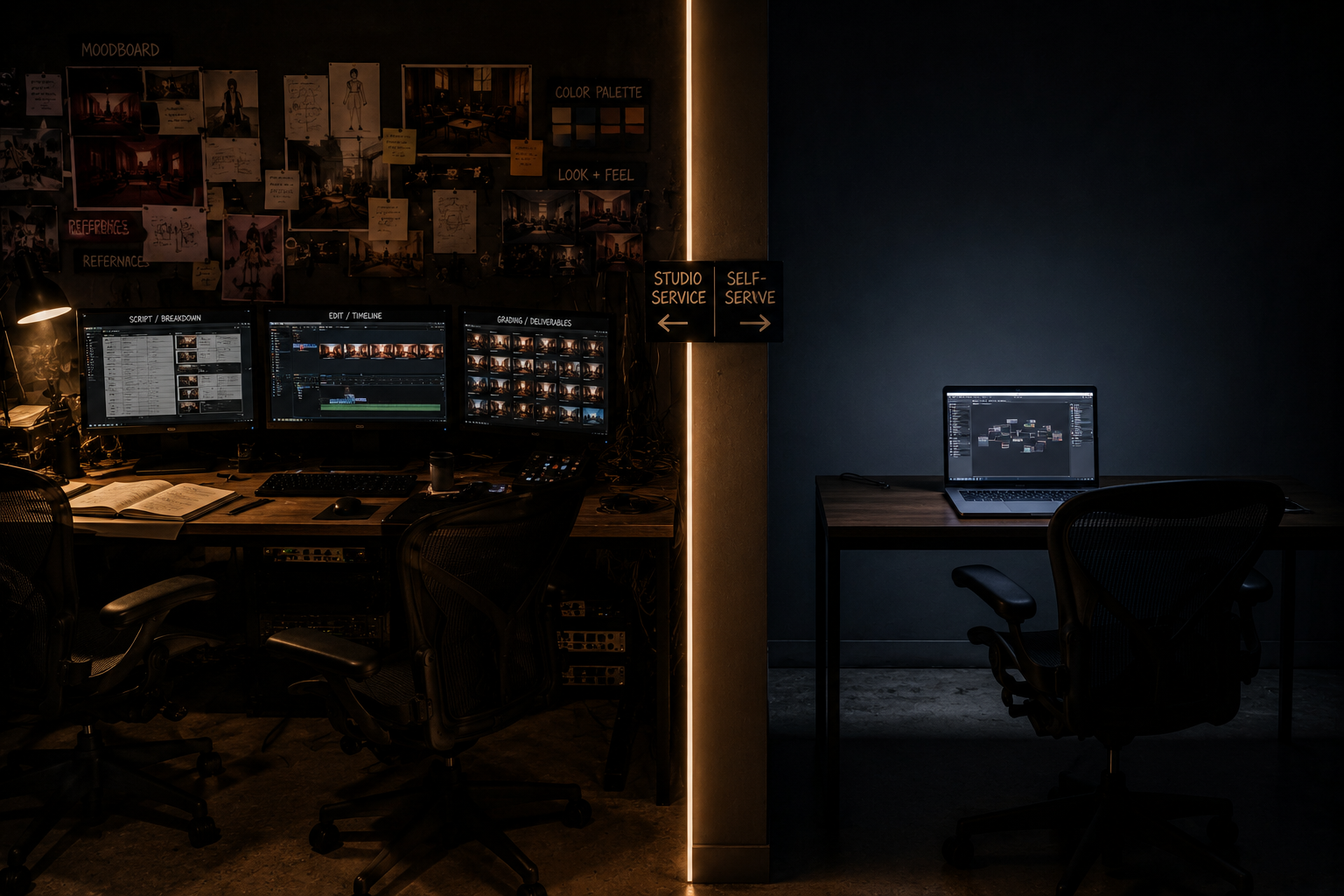
A functioning 24 hour microdrama pipeline needs four layers working together: a script and beat structure tuned for cliffhanger pacing, locked character and world assets that persist across every shot, an orchestration layer that sequences generation instead of leaving it to manual prompting, and an export path that delivers platform ready 9:16 vertical video with captions and metadata.
The Hour by Hour Breakdown
Here is what a same day production run looks like on Vertex, the AI film production OS we build at MinionArts, based on our own productions including Queen of Dragons, a 200 minute vertical animated series completed in roughly two days of production time.
Hours 0 to 2: Script lock and beat mapping. The episode script is broken into shots with hook, escalation, and cliffhanger beats mapped to timestamps. In vertical drama, a hook must land in the first three seconds and a turn every 30 to 45 seconds. This structure is encoded into the production graph, not kept in someone's head.
Hours 2 to 4: Character and world lock. Every recurring character, location, and style reference is locked as a persistent node in the graph. This is the step session based AI video tools cannot do. Once locked, character identity holds across every downstream shot without re prompting.
Hours 4 to 10: Shot generation at scale. The AI Director agent walks the graph, generating shots in parallel against the locked assets. Because continuity is enforced by the graph rather than by prompt discipline, failed takes are regenerated without drift.
Hours 10 to 14: Director pass and assembly. Pacing, transitions, sound, and captions are assembled against the beat map. Retention logic is applied here: cold open placement, mid episode re hooks, and the cliffhanger cut.
Hours 14 to 16: Export and publish. Final 9:16 renders are exported with platform metadata for ReelShort style apps, YouTube Shorts, or owned channels. The remaining hours are buffer for revision rounds.
Why the Economics Force This Timeline
The global microdrama market is projected to reach 11 to 14 billion dollars by the end of 2026, and platforms commission at a pace traditional production cannot match. Production companies like Vigloo now spend around 30 percent of budgets on AI driven workflows and report producing shows in one month instead of three at one fifth the previous cost. Agentic AI workflows have cut vertical drama production costs by up to 80 percent. In that market, a studio shipping one series per quarter is not competing with a studio shipping one series per week. Same day episode production is the unit economics that makes weekly series drops possible.
The Infrastructure Test
If your team wants to evaluate whether your current stack can support a 24 hour microdrama pipeline, ask three questions. First, if you generate shot 214 today and shot 215 next week, will the lead character look identical without re prompting? Second, can one operator trigger a full episode run, or does every shot need hands on prompting? Third, does your output arrive publish ready in vertical format, or does it still route through a manual edit suite? If any answer is no, you have a collection of AI tools, not a production pipeline.
The Three Failure Modes That Kill Same Day Pipelines
Studios attempting same day microdrama production usually fail in one of three predictable ways, and all three trace back to missing infrastructure rather than missing talent.
Failure mode one: the morning rebuild. Teams on session based AI video generators spend the first hours of every production day reconstructing yesterday's context, reloading character references, and regenerating test frames until output matches the previous episode. By the time real production starts, the same day window has already shrunk to a half day window. The pipeline was lost before the first shot.
Failure mode two: the drift spiral. Midway through generation, a lead character's face shifts. The team regenerates, the fix drifts something else, and shot production stalls into a whack a mole session. Drift correction is unbounded work: without locked identity, there is no stable target to correct toward. Days die here.
Failure mode three: the assembly cliff. Generation finishes on schedule, then the episode enters a manual edit suite for pacing, captions, sound, and export formatting. The final ten percent of the pipeline consumes forty percent of the day. Publish ready output has to be a property of the production system itself, not a downstream department.
A true 24 hour microdrama pipeline is precisely the system where all three failure modes are architecturally impossible: characters cannot be un locked, drift has nothing to drift from, and assembly is driven by the same beat map that drove generation.
What Compounds After the First Day
The first same day episode is the slowest one a studio will ever produce, because it carries the world building cost: designing and locking characters, locations, and style rules. Every subsequent episode inherits that locked state for free. By episode ten, the pipeline is running on accumulated infrastructure, and by season two, an entire universe of locked assets is available for spinoffs and sequels at zero rebuild cost. This compounding is the deepest difference between a production pipeline and a production tool: pipelines get faster with use, tools stay exactly as fast as they were on day one.
The market context makes this compounding decisive. Deloitte projects in app micro series revenue doubling to 7.8 billion dollars in 2026, and platforms outside China are commissioning aggressively while supply lags. A studio whose second season costs half the time of its first is positioned to absorb that demand. A studio that starts from zero each season is not.
Frequently Asked Questions
Can you really produce a microdrama in one day?
Yes, for a single episode or short drop, provided characters and world assets are locked in advance on persistent infrastructure. Full 60 to 80 episode seasons typically run over multiple same day cycles rather than one continuous day.
What is the biggest bottleneck in same day production?
Character consistency. Regenerating drifted faces and sets is the single largest time sink in AI video production. Locking identity at the infrastructure level removes it.
Does same day production reduce quality?
Not when orchestration is handled by a director layer. Speed comes from removing redundant re prompting and manual continuity checks, not from lowering generation quality.